Posts Tagged ‘link’

Blog post linking

Thursday, April 5th, 2012

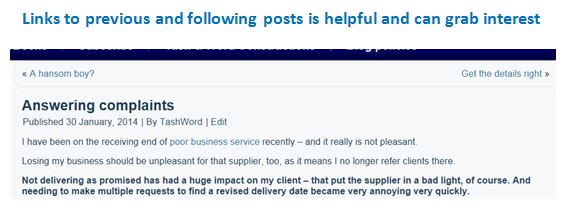
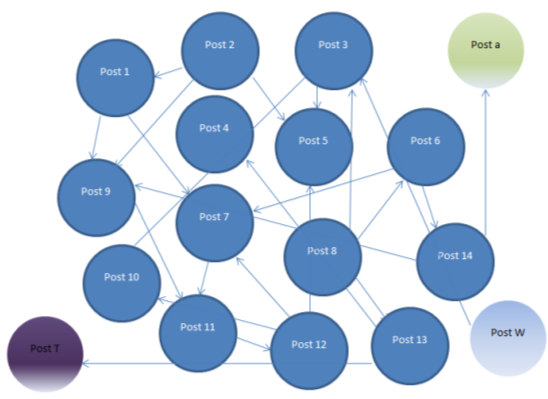
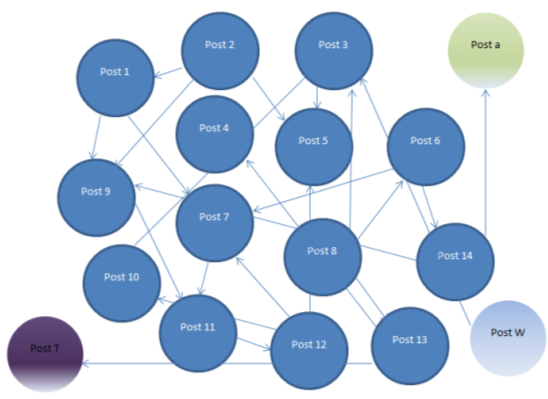
In a recent blog post, Anna Cairo stated that many links to other blogs can theoretically make your blog successful – rather than just the blog itself.

Working together through linksSo how does linking to other blogs help your blog?

  1. you provide additional information for your readers which they will appreciate – especially if you link to someone who gives a different perspective or technical input to your blog
  2. you can support your opinions and knowledge with other posts to build your credibility
  3. search engines give you credit for outgoing links when assessing your blog’s ranking so linking to others, especially other good blogs and posts, is good for your SEO
  4. the people you link to will probably appreciate your links. Many of them will leave a comment in your blog or return the favour by linking to your blog
  5. others’ blog posts can inspire ideas for your own post so why not link back to the post that inspired you? Either as a courtesy or as a means of introducing the issue you are posting about (i.e. it saves you writing out a detailed background for your post)
  6. your blog is more interesting if it has variety and links off to relevant materials, whether on your site or elsewhere – and people are more likely to share interesting posts and blogs than boring ones!

So when is the last time you linked to another blog within one of your blog posts?

Christmas leads in your content

Wednesday, December 14th, 2011

Using topical links and keywords is good for marketing, but perhaps you can’t see how your business can be related to Christmas or other major events.

I wrote about building trust like Santa earlier in the week as a Christmas-related article. Another example of tying in Christmas is to make a list like Santa to prepare for next year’s tax return (note this example has some good ideas but a lot of the detail are US specific and Christmas is closer to their end of financial year, too).

Here are some more ideas for businesses not obviously connected to Christmas to be able to make use of the season in marketing (other than just putting a picture of Santa or a Christmas tree on a webpage anyway):

  1.  make a naughty or nice list relevant to your field. For instance, a list of reasons to proof read or safety equipment for horse riding ae nice lists whilst explaining how to damage your hair or the dangers of sun baking are like Santa’s naughty list
  2. get into the giving spirit of Christmas – give an amount from each sale to a specified charity throughout December or match client’s donations to a charity
  3. Santa, his reindeer and boomers all work hard on Christmas Eve so fitness and nutrition people can easily write about how to prepare and maintain their energy
  4. the reindeer and boomers tie in nicely with animal health and care stories
  5. anybody selling plants or related services can give alternatives to pine trees for decorating or give tips on caring for a pine tree
  6. any service provider can of course promote their services as a means of reducing clients’ work load in the busy November/December period
  7. accountants and bookkeepers can write about the costs of Christmas – tips on avoiding debt, setting budgets, comparing savings systems for next year and so on
  8. psychologists, counsellors and others can talk about relationships, coping with grief or loneliness at Christmas, dealing with stress, setting appropriate expectations and how to fit everyone’s needs into one day
  9. anyone dealing with lights (electricians, bike retailers, lighting shops) could probably come up with a message about Rudolph lighting the way for safety
  10. do some work or sponsoring of a local community group (a neighbourhood house, meals on wheel, elderly club, RSL, etc) to get known locally. You may also be able to use it in a media release, your blog and social media, and possibly in your marketing (e.g. ‘as used by Santa at xyz Christmas party’ or ‘proud sponsor of xyz at Christmas’)
  11. like some houses have an incredible array of lights and paraphernalia, make your business stand out with a Christmas look – maybe cover your company car with tinsel and reindeer ears and use fake snow on the windows, or make your shop window stand out at night with a beautiful display of lights. Either way will catch direct attention and word of mouth, but again you can add it to a blog, media release, newsletter and a picture on your contact page is a nice touch!
  12. arrange for Santa to visit and be in your shop or waiting room for set times

That’s just a few I thought of quickly – what other ideas can you suggest or have done?

Coming up, I will write about general topical connections – it’s too much to do Christmas and general topics on one post!

Sharing restricted links

Friday, July 15th, 2011

Yesterday I wrote about only linking to public material, but what happens if you find a great resource and can’t easily share it?

Here are some ideas on how you may be able to access that information to share it with others:

  • simply ask the owner of the article/site if you can copy it then add it to your newsletter or as a guest blog post
  • pick out key points from the article and summarise them in a blog post or across multiple tweets – it is courteous if you mention the inspiring source rather than just copy their ideas
  • make the link public but include mention of the restrictions (eg ‘only paid members can view’)
  • ask if a public-access link is available somewhere, or if one could be created 

Depending on the structure and intent of the person restricting access to the article, these techniques may be approved and therefore you can share that great information. If not, maybe just tell people that it exists and how they could access it.

Have you ever tried finding a legitimate way of sharing restrictied information?

Choose links carefully

Thursday, July 14th, 2011

While I am fairly new to Twitter (you can see my tweets here), I have already learnt some clear rules about making effective tweets.

In particular, as a  reader of others’ tweets I now know that it is important to link only to public information.

Reading through some tweets I came across someone recommending an article which sounded interesting. As intended, I clicked on the link so I could read the article – and to be honest I almost retweeted the recommendation first but I decided to read it and add my own comments first. Luckily as it turned out.

The link successfully opened a new web page BUT it was the home page of the site rather than the expected article. Annoying enough but I perservered and enterted the article’s title into the search field on the site. Only to get a message that the article was reserved for paid members.

The article may have been great but I will never know.

If you come across a resource you want to share in Twitter (or Facebook, My Space, LinkedIn, etc) then make sure the majority of people can actually access the information. Otherwise you are wasting their time and potentially damagaing your reputation.

Linking from a blog post

Monday, July 11th, 2011

Recently I had a conversation with another blog owner about the number of links included in a blog post; we were specifically discussing guest blog posts but the concept really applies to your own blog posts as well.

He stated that he only accepts two links in a blog post and that having multiple links to one blog from within a post is of no real benefit. Do you agree with the lack of benefit? I don’t.

To me, including links is a means of giving more depth to whatever I am writing about. For example, if I am writing about good business communications I may link the terms good spelling, using capital letters and consistent style rather than explaining the value and meaning of each.

Of course there is also the advantage of potential additional traffic through increasing the number of links to and within my own blog. Even if only one link works for search engines, multiple links give a human more opportunities to visit my blog which is also important.

So for search engines, one link in a post may be sufficient but I see other reasons for adding links and judge the correct number of links by the content of the post (if you look through my blog you will see some posts have one or no links while others have many links).

Side note: limiting the links allowed for guest bloggers is a reasonable strategy, however, to avoid someone trying to spam your blog rather than providing quality content. I respect such limits and live to them when I supply guest posts, even when I think there are more links of value to the reader.

encouraging links to your blog

Sunday, May 1st, 2011

On the assumption you want people to visit and read your blog, it is a good idea to get people to link to it.

Incoming links obviously lets more people see your blog exists and is also good for your SEO (search engine optimisation – in other words, getting search engines to list you high in their results).

I think the single step that is most effective in getting links is quality content – no one will link to your blog if you don’t provide useful or entertaining information. Regular additions to your blog will help bring people back, too, and repeat visitors are more likely to link to you.

Having said that, here are some more specific tips to increasing the number of links to your blog…

  • link to other blogs – only some will reciprocate but it is polite and shows you are part of the blogging community. People seeing your comments may lead to visitors to your blog  or someone else linking to you
  • write something controversial or outrageous (but stay within your brand and identity or it’s all for nothing!) and ideally back it up with your reasons
  • summarise complex issues relating to your topic to help people understand what’s going on
  • disagree (nicely) with someone or a ‘well known fact’ in your industry
  • participate in something unusual and interesting – it could be a treasure hunt across the web, running a competition, blog action day or a local event
  • join in or run a blog carnival
  • offer something valuable to readers – an eBook, a theme, plugin, a sample, etc – that they will be willing to tell others about
  • write something very funny – people love sharing jokes!
  • report on something new – if it is based on research or observations only you have access to, even better
  • be the first to review/announce/do something
  • stay topical – for example, post information relevant to an upcoming event, discuss a news item in relation to your industry or give ideas for the current season
  • get involved in guest blogging – either posting elsewhere or inviting people to post in your blog
  • come up with your own terminology for something – sometimes phrases just stick but people like to read how it originated

It is also important to make your blog and posts appealing so remember the usual things like paragraphs, good spelling and grammar, using pictures as appropriate or for interest, use white space and avoid clutter.

The last tip is to actually ask for other blogs to link to you – but managing that is probably worth a post on its own!

Negative spam comments – why?

Friday, February 18th, 2011

I get a lot of spam comments coming into this blog – I take it as a compliment that they see my blog as worthy of their effort to get included in it. Generally, the spam gets filtered and deleted automatically, but occasionally I look through the comments.

Most of the spam is along the lines of ”Thanks for great information” – presumably on the assumption that I will be flattered and approve it :) Sometimes, it is a question like “who made your blog look so good?” Either way, the links and names not matching emails help give away the true nature of such comments.

Tonight, however, I just read a spam comment that was highly critical of my blog*. I just don’t understand their thought processes – who is going to be sucked in to approving spam that attacks them? Obviously someone who has a lot of spare time if they can send out comments with no chance of being approved to earn them links!

Am I missing something? Have you come across similar pointless comments in your blog?

At least the next comment I read was honest “I am desperate for back links so am putting comments in your blog.” I didn’t approve it either, but they had more chance of success!

*Apart from the obvious link and name clues, I know it was spam rather than a genuine complaint because it accused me of whining in that post, yet the post was a pair of definitions in my Monday Meanings section!

Social media relationships

Saturday, August 28th, 2010

My last post was about networking with a bottle of wine, so I thought I’d also aim it more specifically on social media as Chris did in his original post.

Using social media (facebook, twitter, blogs, You Tube, etc) is in many ways exactly the same as more traditional networking and socialising. Building these relationships depends on being friendly, listening to people and showing interest.

Even the differences are based on the same principles, they use technology to reach those aims. If you met someone at a party, you would answer them by talking; in social media, it is still polite and expected that you answer but you might do so by posting a comment or retweeting instead.

So some social media networking tips are:

  1. be generous with links – if you like something add the link to your blog, tweet it, write about it in Facebook, and so on. It costs you nothing but time, it actually gives you something to write about and is likely to help the creator
  2. visit other people’s blog, Facebook wall, twitter profile, You Tube channel and so on. You can learn more about them than just responding to their emails and comments, and they will probably appreciate you leaving comments when you visit
  3. if networking for your business, broaden your topics – chat with people about other interests (if you network in real life, you’d probably have some references to the weather, the food, the venue or major news/sports of the day, so why not on social media?)
  4. link all your social media outlets – it makes it easier for someone to find what they want but also helps your Twitter followers discover your blog readers, etc.
  5. give more often (by a long shot) than you promote or sell; Chris Brogan suggested a 15:1 ratio – what do you think is a good ratio?
  6. share information on how to socialise online - you don’t need to tell people how to talk but not all your customers and contacts know the purpose of # in a tweet or how to embed a video in a blog
  7. remember to touch base frequently – just like friends drift away if you don’t see them much, online contacts will forget you if you don’t tweet for a month or so.

I’m not a social media expert (closer to the beginner end of the scale really) so I’d love to hear your tips for maximising social media networking…

What makes a good link?

Wednesday, April 2nd, 2008

Every website  and blog owner knows, or soon learns, that links are a great way to build traffic and search engine rankings. And most realise that incoming and outgoing links are both important parts of the equation.

But what makes a good link? How do you want to be presented on other sites and blogs when they are linking to you?

Obviously, you can’t always control how people link to you – you often don’t know about links until after they are established – but if you are prepared, you can increase your chances of getting good links, and offer good ones in return.

Many people assume a banner link (that is, an image of your business is linked to you rather than text) is the best option. This is not really true. People looking at the site may notice a banner sooner than text, of course, but don’t always respond more to a picture than to a few well written sentences. And not everyone realises that a banner can be clicked on as a link – they look for underlined text as a link. What is more important though, is that search engines can’t read images so any text in the banner itself is not picked up by a search engine.

So a text link is often more effective. But even then, some text links are better than others. For instance, a descriptive link to my article on formatting letters is more effective than just a link to Word Constructions as it gives the search engines and readers more information.

As you read my blog and website, you will notice that I try to include a description in every link to add more value to you and those I link to. Is this something you will try now?

Happy writing!

Link to relevant information

Thursday, February 7th, 2008

When writing about a product or information elsewhere, ensure people know what you are referring to. Your words will then make sense, especially if you are giving instructions or reviewing the item in question.

For example, I just read an email that said “Just go to the very bottom of the page and find my items” There was no link and there were no items listed at the end of the email, so I had no idea what page I should be looking at the bottom of!

If you are sending an email and referring to a particular product, webpage, article or whatever, include a link to it or attach it to the email. That way people are not confused and don’t have to waste time trying to find what you are writing about.

Likewise, if you are writing in your blog or on your website, add links to your products, articles and testimonials instead of referring to them and letting people find the information themselves. For example, my article about clear communications may give you more information about why to include a link. But are you going to search for it? Much easier if I say the article is available by clicking on this link, isn’t it?