I hope you find my writing and business tips and observations useful. My business and blog are dedicated to helping businesses communicate clearly and reach their potential.
Read, and enjoy!Tash

Sticking to instructions
Trying something new is always challenging and a bit nerve wrecking.
So it’s easy to rely on sources of information to help the process.
Making tile adhesive
We are doing up our bathroom so needed adhesive to attach the tiles to the bathroom walls. After research, we decided to use adhesive powder rather than a pre-mixed adhesive.
To make the adhesive, it is a simple matter of mixing some of the powder with water. Of course, how much of each is somewhat important!
The packet included instructions for making the adhesive to the correct consistency. However, the instructions were to mix 20 kg with 6 litres of water.

Instructions on the tile adhesive powder bag.
Trying to convert those instructions into mixing usable quantities was difficult – giving a weight rather than volume of the powder was particularly difficult. Meaning our first attempt was too wet and wasn’t going to hold the tiles well enough.
Clarity in instructions
We figured out a good consistency for the adhesive, eventually, and now have some lovely tiles stuck to our walls!
But learning from others’ mistakes, here are my tips for making instructions for useful:
- Remember who the instructions are for and make them suit. That is, don’t assume the person reading the instructions knows as much about your product as you do. If you are only writing for experienced people (in our case, professional tilers), you may be able to give less information than if writing for inexperienced users (such as DIY tilers).
If you have more than one audience, ensure the instructions are simple enough for the less experienced group. - Aim for clarity so people understand how to use your instructions. You can do this through
- avoid jargon
- do multiple small steps instead of a few large steps
- use short sentences
- use simple language and sentence structure
- if the product has different uses, explain how instructions vary between those uses. For example, if floor and wall tiles need adhesive with different consistencies, say something like “Add 6 litres of water for floor tiling and 5 litres for wall tiling” rather than “depending on the consistency of the mix required”.
- Where measurements may vary, give a ratio or multiple examples. I’ll expand on that in my next post 🙂
- Put instructions where they are easily seen – not just so they can be found but so that they are easy to refer to whilst using them. Again, with the tile adhesive packet, the mixing instructions were in amongst paragraphs of text.
What interesting experiences have you had with hard to understand instructions?
Take care with huge claims!
It will be my son’s birthday soon and we’ve been looking for a present for him – he adores Lego so we want to get him some miscellaneous bits to play with as well as the sets he already has.
Our search moved onto eBay where we found some listings for bulk lots of Lego.

My son has a lot of Lego – yet I wouldn’t describe it as a huge bulk lot of Lego!
A few items suited what we wanted and we placed some bids.
Other items didn’t suit so we moved on.
A number of items listed as ‘huge bulk lot’ (yes, there were more than four or five of them! And all seemingly from the same seller) amazed us 🙂
Over promising doesn’t get the sales
What does huge mean? It is something of great size or quantity.
And what does bulk mean? Again, it is about size and, in the context of purchasing items, means a large quantity of something.
So when I look for bulk Lego, I expect hundreds of bricks or even kilograms of Lego.
I don’t consider six wheels or 13 small pieces of Lego to be a ‘huge bulk lot’. Yet the aforementioned seller apparently thinks differently to me!
Needless to say, we’re not interested in buying tiny ‘bulk’ packs of Lego.
Calling his packs of Lego ‘huge bulk lots’ may have attracted people wanting bulk lots – but it wouldn’t be bought by them.
While people after smaller packs of specific bits of Lego wouldn’t necessarily search for bulk packs.
Either way, the seller isn’t using a smart strategy in my opinion.
Over use of adjectives
Adjectives can be useful for providing information and making writing more interesting.
Yet there are two details to remember…
- the adjectives need to be honest and actually describe the noun(s) or the writing just loses credibility
- too many adjectives is not helpful. People start to glaze over when there are too many together – I know that in my busy life, I don’t have time to wade through lots of meaningless adjectives to find out the information I really want so I’m less likely to read something that appears hyped up.
How’s your business – do you add adjectives to hype up a product or keep them to a meaningful minimum? Maybe you have tested it and found lots of adjectives sells more – if so, I’d love to hear your experiences!
also comes after
Reading and editing a document recently, I came across the following text as the first paragraph in a new section of the document:
We will also deal with your request for access…

‘Also bring an apple’ comes after ‘bring pen and paper’ or else ‘also’ makes no sense.
So today’s Monday Meaning is for one word instead of a pair of words.
Also [adverb]: as well as, too, in addition, besides
Please bring pen and paper. Also bring a snack.
Getting back to the example above, it is wrong because ‘we’ can’t ‘also’ deal with a request if ‘we’ aren’t already dealing with something for you.
Words like also and too must follow, or come after, something rather than being the first item in a list.
Facebook ads – short but important
Proof reading is important – even for short and (relatively) simple things like a Facebook ad.
A Facebook ad that needs proof reading
Unfortunately my screenshot didn’t work (and the ad hasn’t shown again since!) but I saw an ad this morning that seriously needed some help…

Even short pieces of text need to be proof read – or risk embarrassment
The heading of the ad was “New year. New hom.”
For a major company involved in real estate sales, you’d think home is an important word to get right.
I’d also have expected a company of that size to have a process of checking and approving ads before they go live – a one-person business is often at bigger risk of such errors because it is harder to correct your own writing.
The body of the ad included “but hurry – offer ends 28 February!”
Perhaps they meant hurry into your time machine?
That isn’t necessarily a proof reading error (unless they actually got the date wrong!) as it may be an incorrect setting on when the ad is to be run. Either way, attention to detail can have a big impact!
Proof reading matters…
We all do it – we write something and assume it is written exactly as we meant it to be.
But between typing mistakes (typos), thinking faster than we can type and actual spelling/grammatical errors, it is easy to have text that is not exactly what we wanted.
So we need to check our writing for errors. ALL our writing, whether short or long, whether technical, legally required or marketing, whether online or offline. It’s that simple!
And the key proof reading rules are to get someone else to check it and leave some time between the writing and proof reading.
Oh, and don’t rely on spell check to find all your errors, either. For example, in this post I typed ‘won’ instead of ‘own’ and a spell check would have accepted that as fine.[Tweet “Leave time between writing and proof reading, and don’t rely on spell check…”]


Keep it simple…

Simple but clear – this image tells a story without trying to impress or be more than it is. This makes for good communication.
The purpose of the written word is to communicate.
Sometimes that does include some complexity but I strongly believe it should be kept as simple as possible. Why make people work hard at understanding and increase the risk of misunderstanding?
I recently came across the following:
Email us to inform us about updates regarding your personal information.
And it struck me how some people try to impress and seem ‘professional’ by using complexity when it really isn’t needed. In the example above, why not just write:
Email us with any changes to your contact details.
Consistent pronouns
Mixing pronouns is a little like mixing drinks – both can lead to a fuzzy head!
Pronouns
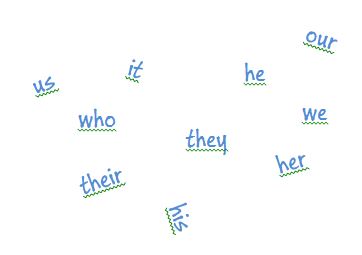
Some common pronouns that make writing (and reading) English much easier.
Just as a reminder, a pronoun is a word that is used in place of a noun. So ‘he’ replace’ John’ and ‘her’ replaces ‘Suzie’s’, and so on.
Pronouns are useful for
- making writing shorter and clearer (it takes less to write ‘they’ than ‘John, Mary, Chuan and Connor’ for example)
- avoiding repetition of the noun (compare ‘Joe rode Joe’s bike until Joe felt too tired’ and ‘Joe rode his bike until he felt too tired’)
- provide emphasis towards one noun (such as ‘The teacher herself missed the error in that question’). Mind you, this is a somewhat old fashioned way to write and I don’t recommend its use in business writing.
There are different pronouns depending on gender and whether the noun is plural or singular.
Use pronouns consistently
When using pronouns, make sure you maintain the same or matching pronoun throughout a sentence and paragraph.
I recently read
For more details about {our product}, contact us on 1234 5678 or visit their website.
The writer swaps from being part of the company (by using ‘us’) to being external to the company (by using ‘their’). Which is jarring and somewhat confusing.
If in doubt about which pronoun to use, swap in the correct noun and make sure the sentence makes sense.
Or make a conscious choice about the type of pronoun (such as if your business uses me or we, us or it), put it into your style guide and stick to it.
Do you have any trouble with pronouns? Have you ever checked the pronoun use on your website is consistent?
Communications can win or lose votes
I don’t watch politics for fun. In fact, I don’t like politics very much at all and I often find their behaviour childish. Childish in a way I wouldn’t tolerate from any actual children…
Yet I am going to write a blog post inspired by a politician and Saturday’s election. It is mainly about their communications so no need to hide from another political statement!
Checking my options

I am proud of Australia and am willing to welcome refugees.
Earlier this week, I went to a number of websites to find out more about the smaller parties. Namely because I can’t bring myself to vote for either major party this year – blocking refugees asking for help is simply wrong.
On each site, I looked at their policy ideas and details on their candidate in my area.
Learning from their websites
Based on reviewing a few sites covering the same basic idea (ie what the political party stands for and why we should vote for them), here are some useful website tips for us all:
- Summaries and simplicity are good.
A short summary of each policy area with a link to greater details made one site much easier to read and quickly gave me an overview of the party. The lists of actual policies were also brief and to the point. It was therefore easy to decide whether or not I liked them.
Other sites waffled on or gave me a long list of policies to choose from which was more intimidating than a single-page summary. - Dead links are frustrating and reduce your credibility.
One site had my local candidate listed but every link on his name took me to an error page. Given I found the rest of the site a bit vague, I really wanted an impression of him to make a decision. Instead, I was frustrated and didn’t feel the party was very professional or reliable. - Explain who you are fast.
One site (and I spent very little time on their site once I started reading their offensive nonsense, so maybe there’s a reason for their web design!) had a huge banner and blog posts on the home page. It gave me no idea of who they were (not even that they are in fact a political party) which is what I wanted to know – their latest news is in the realm of politics I don’t care about!
A clear tagline, an introduction or useful imagery can give information to site visitors quickly and makes life easier for people. - Show information, or don’t – changing is annoying.
I clicked through to an inner page which was basically a list of questions. Initially, I saw questions and answers but as I was part way through reading the start of one answer, it disappeared to show me a list of questions. Obviously, their software is set to narrow the content to just the questions but the loading time was so slow it showed answers first. Very frustrating to deal with as a site visitor.
Have you checked how your clever settings actually work for site visitors? Often a simple solution works consistently so is better than a fancier option.
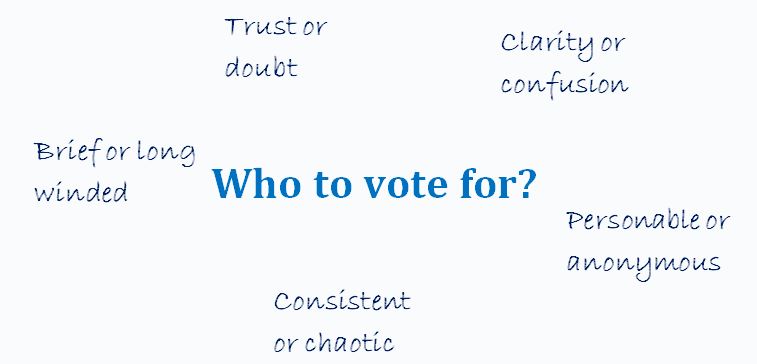
What characteristics are important in choosing where to vote or spend your money?
Learning from the candidates
Remember how I couldn’t find information about my local candidate above? I found a media release about him and some others in his party which my local candidate had replied to in the comments.
There is both good and bad to be learned from those comments…
His first comment was long. Maybe a third of a page without paragraph breaks long (lack of structure may be due to the software, which is on the party not him, so I’ll give him a pass there!) It started with a lot of impressive words strung into a sentence or two that made absolutely no sense. Instantly I had no faith in him and no desire to vote for him.
The lesson – make sure anyone representing your business online can write reasonably well or do it for them. A genuine message is better than trying to impress readers.
However, I will give him credit for answering multiple people’s questions to the media release. Responding to comments and questions showed enthusiasm and passion, and listening to people is a precious commodity when it comes to politicians.
Yes, some of those answers were long winded and were nice ways of fobbing off hard questions but he was trying.
The lesson – respond to people online to build rapport, show your personality and gain another opportunity to explain your purpose or skills. Remember, people may see this rather than your carefully crafted profile – especially if a link is faulty!
What have you learned from this election?
Have you come across examples where a politician or political party has communicated well or poorly?
Maybe some of the above examples have inspired you to check your own website with a different perspective. If so, I’d love to hear about it in the comments below…
While I am not going to vote for a party just because they did the best job with their website, being able to easily understand the party does influence my choices.
Just like as a business owner or consumer I am not going to buy something just because you have the prettiest website, but I am more likely to trust you (and thus give you my money!) if your site is professional, simple to use and inoffensive.
But based purely on my descriptions of their websites, who would you vote for from the above examples?
Personally the first site I mentioned would get my vote – their summaries and easy-to-navigate site made it easy.
Without context, messages get lost
In an article about Australian Standards on what I thought a national-focus site, the following section stood out…
The retrofitting of automatic sprinkler systems became a mandatory requirement for existing aged care facilities in January 2013. Similar requirements also exist in Victoria and Queensland.
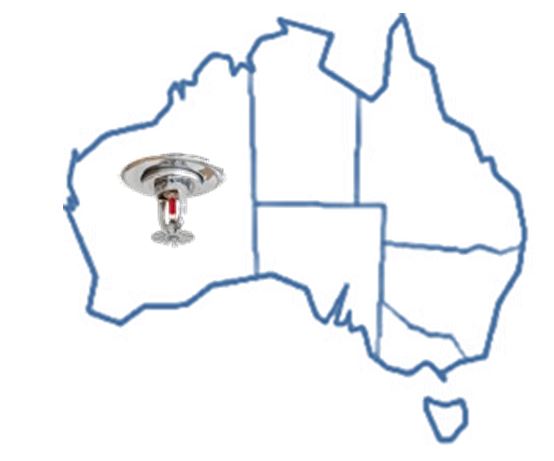
Does a national law only cover one state?
So two states have similar laws to the national laws? Why are the national laws not, well, national?
Or is the author just assuming everyone knows he is writing about a particular state because it is so important and somehow obvious?
Or was something edited out that made it clearer in the draft?
Fire safety is important – but so is clarity so people understand your message.
Clarify your context…
When proof reading and editing, always make sure you read your writing from start to finish to check the correct context is in place.
A better way to write the above sentence (and I’m guessing which state is the assumed one!) would be…
In January 2013, the retrofitting of automatic sprinkler systems became a mandatory requirement for existing aged care facilities in Tasmania, Victoria and Queensland.
I think it would also be nice to add another sentence along the lines of “The other states are reviewing their laws” or “Currently the other states have this as a voluntary measure”. I prefer to get the whole picture, but that could just be me!
If you want to avoid similar errors, let me know – I offer proof-reading and editing services as well as writing 🙂
Poor surveys are time wasters…
I’m busy, you’re busy and I suspect even people (including Government employees) writing surveys are busy.
So why do people put up silly surveys and waste everyone’s time?

Throwing time away…
Late last week I was asked to fill in a Government-run survey gathering information to help small businesses – a worthy cause so I completed the survey.
But some of the questions were a waste of time – not only were they hard to answer, I doubt they will give meaningful results so it has wasted everyone’s time.
Poor survey question samples
Here are some of the worst questions I answered, with my comments to explain why I didn’t like these particular questions.
Q1 – is your website interactive? Can you edit it yourself (eg online forms, content)?
A1 – yes or no
What is the correct answer if my site is interactive but I can’t edit it, or if I can edit it but it isn’t interactive?
Q2 do you use a still or video camera for work purposes?
A2 – Yes – what do you use it for?
Um, for taking photos or videos? I wonder how many people gave that answer! I decided to be nice to them and answered ‘take photos for use in my blog’. Or did they want to know if I use photos of videos?
Q3. who is your local IT service company in a, b and c?
Personally I had no idea! And what did they mean by local anyway – same suburb, same city, same state?
The question perhaps makes more sense if you assume they want to know who I used for those services or maybe they were trying to ask ‘do you use a local IT service company for a, b or c’.
Q4. how do you get business advice and information?
A4 – rate each option in the following list {which includes trade magazines, state gov department website, dept of broadband, communication & digital economy}
The list did not include professional advice (accountant, coach, etc), online articles/blogs or government business info sites which were the first three things I thought of! Yet it included such specific things as a government department site and the dept of broadband, etc which I have never heard of!
When giving answers, it is important to review the list to ensure it covers enough breadth – or change the question to indicate it is a narrow aspect being researched.
Q5. do you or any of your staff telework? (work from home connecting remotely to the business network and database.)
How do I answer that – I work from a home office so I am nearly always connecting to the business from home but I don’t think it is really telework when the network is also at home!
Do they want me to include sub-contractors/suppliers as staff or keep ‘staff’ to mean employees?
Maybe this post will compensate for the wasted time as at least we can all learn what not to do in our next survey or feedback form!
My strong recommendation is to always get an outside person to read a survey when you think it is finished because they will spot errors in logic, assumptions and inconsistencies better than you can.
What are your survey stories? Have you found they are harder to write than they appear? Or maybe you’ve come across some time-wasting questions like these ones. I’d love to hear them – although it would be nice to think most surveys are well done!
You can write great client letters
I wrote about an officious bank letter that resulted in me closing my account.
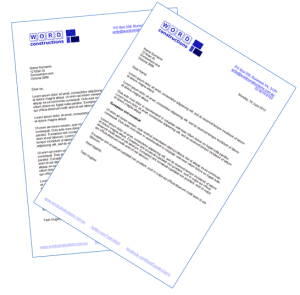
Professional looking letters are part of your brand
There was more to that letter for teaching about good letter construction, so here are some tips for you…
- the letter was on two pages
This was unnecessary, unavoidable and can really annoy readers. It looks longer so is off-putting and is just a waste of effort. With better writing it could easily have been shorter and their letter format included a lot of wasted space. - one line of the letter contained only ‘if:’
It is best practice to avoid a single word on a line (designers call this as leaving orphans and widows), especially such a short word - every number in the letter was written as ‘three (3) years’
Frankly, people can either read or they can’t, so ‘three’ or ‘3’ is sufficient – adding both is unnecessary and looks wrong - first sentence is 3.5 lines long…
It was simply too long, both visually and for comprehension. When in doubt, go for shorter. - lack of clarity throughout the letter
The letter went from the consequences to the definition to the impact for me so it was hard to follow – I had no reason to care about the consequences until I knew the relevance and definition!
Remember to explain the relevance of any information first. They could also have improved it a lot by using a sub-heading for the full definition of inactive account – I could skim that section or read it for details without feeling confused. - a missed personalisation opportunity
The letter stated ‘your account referred to above’ – it’s not hard to mail merge (and they were already merging in my name and address!) so why not use ‘your xyz account’ which is more personal and easier to read - an entire section was irrelevant to me
why include a long paragraph, including two bullet points, on offset deposit accounts when I don’t have one? Setting up a conditional rule on this paragraph would be easy to do so it only goes to relevant clients. Or at least have it under a sub-heading so it doesn’t clutter the main letter and distract from the meaning
Recent Comments