I hope you find my writing and business tips and observations useful. My business and blog are dedicated to helping businesses communicate clearly and reach their potential.
Read, and enjoy!Tash

A funny gesture?
“I use to get jewelry and a print or something they made . It was a nice jester.”
This is a comment I spotted on social media recently in response to a request for some gift ideas. It took me a moment to realise that ‘jester’ was meant to be ‘gesture’, but then it all made sense.
I must admit this is not a pair of words I had thought of as spelling options before, but I now know they can be confused so here are the meanings…
jester [noun]: a person who entertains, especially in medieval times, and often does so through silly behaviours. Also known as a fool, a jester often wears a funny hat with bells hanging from it.
The King laughed as he watched the jester before dinner.
gesture [noun]: a movements of limbs, head or body to express an emotion or thought.
A nod of the head is a gesture of approval.
The key thing I can see that may help you know which word to use is the relationship between jest (to joke or laugh) and jester.
also comes after
Reading and editing a document recently, I came across the following text as the first paragraph in a new section of the document:
We will also deal with your request for access…

‘Also bring an apple’ comes after ‘bring pen and paper’ or else ‘also’ makes no sense.
So today’s Monday Meaning is for one word instead of a pair of words.
Also [adverb]: as well as, too, in addition, besides
Please bring pen and paper. Also bring a snack.
Getting back to the example above, it is wrong because ‘we’ can’t ‘also’ deal with a request if ‘we’ aren’t already dealing with something for you.
Words like also and too must follow, or come after, something rather than being the first item in a list.
A hansom boy?
As always, I help Love Santa write and edit some special letters each December.
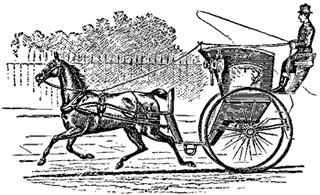
A 19th century engraving of a Hansom Cab in motion. Hansom cabs were designed to be faster and more agile than older horse drawn carriages.
As I edit, I check the supplied information works in the letters, fix up capital letters and adjust any spelling errors.
In one letter I edited a few weeks ago, I came across a misspelling I’ve never seen before so it has inspired today’s Monday meanings 🙂
handsome [adjective]: attractive, good looking; significant
You are such a handsome boy!
He received a handsome package when he retired.
hansom [noun]: a horse drawn two-wheeled carriage with a covered area which the driver sat behind and above. The hansom cab (named for its design) was the forerunner of the term taxicab and cab that we now associated with hired vehicles.)
Sherlock Holmes jumped aboard the hansom cab and was off!
How to remember which is which?
A hansom cab was designed to be sleek and fast so it has fewer letters than the significant handsome.
Alternatively, you may find it easier to think of a handsome person having a hand which a hansom cab certainly does not!
Monday meanings: a dearth of life
For today’s Monday Meanings, I thought I’d follow on from Friday’s post and my personal recent history by defining death and dearth.
Apart from an obvious similarity in spelling with one letter difference, death and dearth do have a certain similarity in meaning too. neither is a cheerful word and both are about a lack or loss. To me, both give the impression of barrenness, isolation and gloom.
Do you find these words similar or just words that happen to be spelt in a similar way?
Death (noun): the end of life, a cessation of being alive.
Liz was completely alone at the lighthouse after Jack’s death.
Dearth (noun): a scarcity or lack of something
There was a dearth of vegetation and colour in all directions.
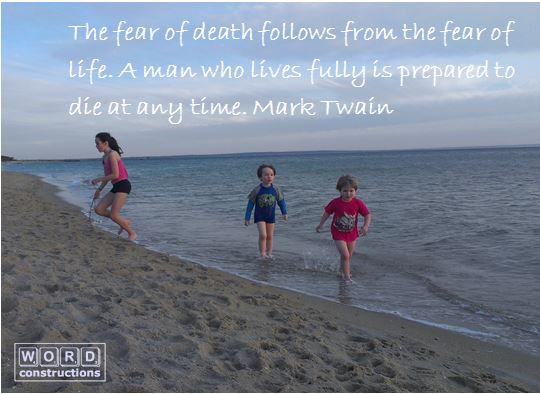


Avoiding lots of waste or a big waist?
Today’s meanings were inspired by a blog post where the word waist was used instead of waste. In this instance, I pointed out the error and the blogger was able to fix the post.

A waist goes in, like the provernial hourglass figure, so maybe this image will help you remember which wasit to waste!
waist {noun}: the area bewteen a person’s rib cage and hips; the narrow area of any object that widens at both ends; the part of clothing that covers or sits on a person’s waist
Women used to wear corsets to have a smaller waist than was healthy.
waste {verb}: to use, consume or lose something carelessly or thoughtlessly
Being careless about turning taps off leads Jack to waste a lot of water.
Don’t waste bloggers time when offering guest posts.
Hmm, so how to remember which waist/waste is which? Just think of that little i in the middle of a waist being like the smaller part of a shape.
Are simple messages simplistic?

Simple and simplistic are not the same…
While being closely related with the same root word, today’s pair of words are quite different – and understanding them can be quite enlightening.
simple [adjective]: basic; missing elaboration, ostentation, complication and subdivisions
Basic arithmetic is simple to write and calculate; quadratic equations are not so simple!
Following main roads is simpler than maneuvering through side streets.
In grammatical terms, simple means having only one clause without any subordinate clauses or modifiers.
simplistic [adjective]: over simplified, missing information or depth
Saying income is the indicator of career success is simplistic.
We’re going where?
Doing some marketing research for a client, I came across the following sentence:
With over 37 year’s experience, where sure to make your Christmas party a huge success!
I admit I was stunned to see this error and thus a new Monday Meaning post was inspired.
where: [noun] location or place; [adverb] in what place/position/respect; ]pronoun] which place or point?
I wonder where Simon will be on Christmas Day this year?
we’re [contraction]: we are – we’re is simply an abbreviation of ‘we are’ where the apostrophe replaces the space and letter a.
We’re going to my Father’s house for Christmas lunch this year.
I’m also adding a word that sounds different but has similar spelling and does sometimes get used in place of where and we’re.
were [verb]: ‘to be’ in the past (ie the past tense) for a plural (we, they) or second person singular (you) noun
We were at my Uncle’s last Christmas Day.
Just how exhausting is a study?
I recently posted about an exhaustive study of twitter users and it reminded me of another pair of words that can be misused.
exhaustive: covered all angles and possibilities
The SES conducted an exhaustive search of the area but found no traces of the girl.
exhausting: to use or consume entirely, to drain or tire
The two day Problogger event was exhausting so I slept in the next day.
I don’t think exhaustive is used very often now; you are more likely to read about something being comprehensive or detailed. Of course, it has a slightly different meaning to comprehensive which means covering a wide range – it can include most or all aspects.
I assure you of the meaning
Today’s Monday Meanings is an interesting set of words.
All three words have a similar sound and very similar meanings – they all relate to making certain and secure. However, they are generally used in different contexts.
Assure: speak positively to convince, make certain, make safe, ensure
The police will assure the family that all is being done.
The CEO will assure this job is yours once she returns from lunch.
Ensure: make certain, make safe, secure
Preparing a first aid kit will ensure a safer trip.
Insure: to guarantee or provide indemnity against harm or loss, usually in the form of money
I pay a premium so the company will insure my business against theft and fire.
So which word to use when?
insure is used where financial matters are involved – relate insure and insurance basically.
assure is mostly used on connection with people or other living things (a for assure and a for alive can help remember this one!) – ‘I assure you’ – and can be related to reassure
ensure is more about events and things – think of ensure as a guarantee that something will happen
Have a go yourself…
Here are some examples for you to try the three words in…
Mary wants to ……. her business equipment.
Jane will …….. the blog posts are uploaded on time.
Ashton hastened to …….. staff that their jobs were secure.
The leader carried an extra blanket to …… the cubs were warm.
Comedy writers ……… readers of a laugh.
Not all companies will …….. a sole trader business.
* Image courtesy of 123rf
Recent Comments