I hope you find my writing and business tips and observations useful. My business and blog are dedicated to helping businesses communicate clearly and reach their potential.
Read, and enjoy!Tash

How to get writing, no matter what
Finding it hard to write on demand, struggling with ‘writer’s block’ or doubting your ability to get something written?

Do you have the time to waste on not writing?
Long ago I decided I didn’t have the luxury of ‘writer’s block’ and I can write on demand rather than waiting for inspiration or the right mood. There are certainly times when I really don’t feel like it, but I have found ways to keep writing anyway.
Some people will say writing when you don’t feel like it means your writing isn’t as good. That maybe true for creative writing (although many novelists would disagree) but if you write professionally you have to meet deadlines for clients whether or not the whim takes you.
Tips for overcoming writer’s block – or writer’s hesitation
Here are some useful techniques, some are well known and some have been really valuable for me over the last nine or so years.
If you have any great tips on how you overcome writer’s block, please share your ideas in the comments section below.
- just write. It doesn’t matter what you write – just sit at a keyboard or with pen in hand and write for five minutes without stopping. It gets ideas flowing and sometimes gets doubts out of your head. You may find you are ‘in the mood’ well before your five minutes is up…
- forget the start. If you’re sitting in front of a blank page not knowing how to introduce a document, or what title to give it, start writing the middle of it. For an article, write the middle and come back to the introduction and title; for a longer document, choose any chapter but the first and write that. Apart from getting you started, an intro or title often needs revising once the rest is written anyway so leaving it to last makes a lot of sense
- if you know broadly what has to be written, write out all your headings and sub-headings for the document. It’s much easier then to just fill in the text between headings in whatever order you feel like
- give yourself permission to just write – don’t worry about typing perfectly, getting spelling and grammar right, or having the perfect word in every instance. Get your first draft written and your project is underway – much better to have it all written and spend time proof reading than to have only a paragraph or two written in the same time.
- know yourself so you can set up the best conditions for writing. It may be first thing in the morning, after doing some exercise, with music playing or in silence, at a keyboard on a desk, or any combination of circumstances but use your environment to encourage your writing
- like that proverbial elephant, don’t expect to tackle a big project in one go. Set yourself small targets – yes it can be ‘have the first draft finished by Thursday’ but it can also be goals like ‘write for 20 minutes then check emails’ as doing something hard or unpleasant is easier to face for a short time
- build habits – if you sit at your computer to write at 10 o’clock every day, your mind will expect that and be ready to write
When it comes down to it, the only solution is DO IT!
I find that if I don’t feel like it but start typing I get into it and can write the document easily – and often finish it ready for another! If none of the above helps get you writing, your other option is to ask someone else to write the document or web content for you.
Why do small businesses start?
I spent last night talking with my daughter about her subject choices for school. It’s not an easy decision and there are more interesting subjects than there are spots in her timetable so each subject has to be considered for its merits.
One subject we discussed was Small Business Management (note the capitals as a subject name). The course description included ‘find out why small businesses start, what sort of businesses there are and small business marketing’.
I thought that to be an interesting choice of topics – there are so many reasons people start small businesses! Do they study a regimented ideal or will they really look at the breadth of small business types, structures and reasons for existence?
My daughter was really pleased I offered to talk to that class if the teachers wanted me to, which was nice but slightly off my topic 🙂
Why did I start my small business?
 I can’t answer a simple question of why small businesses start – I think there are too many reasons to cover simply. But I can tell my story.
I have always been able to write (ok, since I passed Prep anyway!) but it took some time for me to realise that I do it well compared to many people and with relative ease. My love of reading and writing has certainly been a big part of my life – English was always a favourite school subject.
The idea of working for myself appealed, but I didn’t think I had anything worth selling nor the capital to start a business. So I had a variety of jobs until I was home with young children.
Thinking about what I wanted to do, work wise, so I could build skills in between parenting tasks, I liked the idea of being flexible so I was available for my children and just reporting to myself.
A friend asked for some help with her resume and covering letter – and was enthusiastic about the results and commented on how good I was at writing and seeing to the point of what needed to be written.
I helped edit the cookbook our kinder created as a fundraising project.
Then the penny dropped and I fully realised that good writing is a valued commodity that I can provide, and that running my own writing business would offer me flexibility and control.
It was also a business I could start with little financial outlay so I dabbled, got some initial clients and then set up business properly.
Are starting reasons the ongoing reasons?
I find it intriguing whether or not the reasons someone starts a business are the same reasons that keep them going a year or five years later.
Word Constructions was started so I could be at home, working around my children, using my skills and being my own boss.
Now, nine and a half years later, it still gives me flexibility for my children, utilises my (more refined) skills and lets me be my boss (although clients have a certain amount of control, too, really!). I find that it also has developed a passion for clear communications – a passion to see more clear communications and to help other businesses communicate more effectively.
How about you – are your motivations the same as when you started a business? If not, how have they changed?
My passion to help others communicate clearly fuels this blog, my Twitter objectives and my monthly newsletter.
6 steps to getting a website online?
Welcome to the first in a series of posts about getting your business online. Even if you are not yet sure you will start a website, the aim is to give you the information to make an informed decision for your business.
 So let’s start with the basics of what you need to do to get a website up – and let’s make it a decent website that your business doesn’t need to be ashamed of! (We could get a website up in about 10 minutes but it may do more harm than good!)
- get a domain name – I suggest doing this even if you don’t add a website for some time. Keep the name for your use and you can use it as an email address even if there is no functioning website yet
- get a web host – this means you are paying someone for some space on the internet. There are many hosting packages available, covering various features and a huge price range – it is feasible to get hosting for under $100 a year so look around. We’ll cover hosting options later in this series, but I strongly recommend my host, Digital Pacific.
- get some information online – you can start with a very simple one-page site that explains who you are and how you cane contacted. You may be happy with that in the medium term, too, but it certainly gets you online while a full site is being developed.
- get your site designed – yes that means someone makes it all look nice but it may also mean getting the right programs in place to suit your business needs.
- add content to your website – content is critical if you want to get the right message to the right people, and if you want to do well with building your website traffic. Look through my blog for numerous examples of websites let down by poor content – I suggest you plan your content (we’ll cover this during the week, too, but make sure your key pages have great content from the start)
- let people know about your website – this is a big ‘task’ and will be ongoing for the life of your site, but there are some simple starting points to action straight away
Does a website seem a little less intimidating when there are only 6 steps? remember that you can (and probably should for many of the steps) get help with the actual implementation of each step.
As a website without a host is pretty hard to manage, the next in this series will be on hosting…
How to overcome writers block
Have you ever had to write something but just can’t find the words to start?  Many people face this problem, and some find writing a problem every time they try. So here are some sure fire ways to get yourself writing when it seems impossible…
- start writing– get your fingers moving on the keyboard or the pen on the paper with any gibberish that comes to mind. Type nonsense, whatever is in your head, a shopping list or even ‘I don’t know what to write’ over and over. Action often induces the brain into the right thought patterns
- start with something easy in a big project – if you find the introduction too hard, leave it to last and start with as easy bit. For example, get the contact us page written before the home page as it will get you started
- give yourself a tight time frame and stick to it – add a reward if that works for you. For instance “I have to write for 30 minutes before I go to lunch” or “Once I have written 500 words I can call Mary for a chat”.
- set the mood – play some Mozart if you can as that stimulates the brain
- move to a new place. If you’ve been at your desk all day and you just can’t get writing, grab pen and paper and sit under a tree, curled up in a favourite chair or just turn so your back is to your computer, or try a brisk walk around the block or do some stretches. A change of scenery and/or activity can be enough to start the words flowing
- forget about good grammar and spelling, flow and other writing techniques so you can concentrate on writing – you can refine the details later but the words and ideas must be written to be useful
- write out the headings and sub-headings – it is shorter and simpler than writing the full content so is a good starting point. It will also then make it easier to actually write the content because the ideas are already laid out for you
I will do another blog post on setting things up to reduce the risk of writers block, but for now stop reading and start writing!
Capital letters
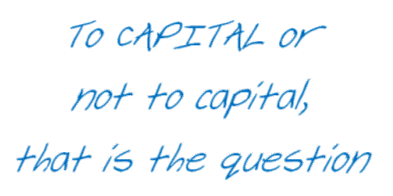
Pardon changing the Bard’s words, but this is a question that needs asking much more often …
I suspect the increased use of SMS and chat shorthand is a major factor, but it seems that many people aren’t sure about when to use capital letters in their writing. So here is a quick summary of when to use a capital letter:
- for the word I – this word must always be written as a capital letter, to do otherwise looks out of place and attracts attention to the lack of attention to detail. As part of an SMS message, I might accept it, but I leave websites where they repeatedly use a lower case i
- to start a sentence – this helps make it clear it is a new sentence and this in turn makes it easier to understand the message and individual ideas
- for all proper nouns – that is, any word that is the name of something specific for example Tash, Melbourne, Australia, Australians and Word Constructions. It does not include generic names such as mothers, business owners, writers, city or students.* Note that the word I is actually a proper noun so my first point is covered here but it was worth a separate point!
- in acronyms – where just the first letter of each word is used to represent the name of something. For instance, the ATO represents the Australian Tax Office and ASAP represents as soon as possible. It doesn’t matter if the full title uses capitals or not, acronyms generally use capitals (sometimes a business may choose to brand themselves with a lower case acronym)
- the start of speech, even if it is not the start of a sentence. For example, she said “We must pay attention to the use of capital letters.”
- days of the week and names of months, as well as names of specific periods of history (e.g. the Second World War, the Depression)
- titles of books, articles, movies and so on can be written in title case (e.g. Full Moon Rising) or just with a starting capital letter (e.g. Confessions of a supermom)
Capitals letters are sometimes also used within names (e.g. AvSuper, MacGregor), in scientific terminology (e.g. E. Coli, Eucalyptus, cyclone Tracy) and where two words have been abbreviated into one (e.g. eBooks, eLearning.)
There are variations in some of these rules, especially if you travel to another country but using these guidelines will avoid any major errors! Or call upon someone to check your writing for you – errors that requires conscious effort for you to find often are quite obvious to others, especially to someone like me who spots such things without trying.
Edited to add: I came across a fun poster with the basic capital letter uses, which is great for kids and anyone struggling to remember these rules.

* The use of a generic noun as a proper noun requires a capital letter, too. So while mothers is written in lower case, a capital letter applies in the following sentence: Mary said “Hello Mother. How are you?” Likewise, you may write about a library (generic) or the Ashburton Library (specific).
Recent Comments