I hope you find my writing and business tips and observations useful. My business and blog are dedicated to helping businesses communicate clearly and reach their potential.
Read, and enjoy!Tash

Keep it simple…

Simple but clear – this image tells a story without trying to impress or be more than it is. This makes for good communication.
The purpose of the written word is to communicate.
Sometimes that does include some complexity but I strongly believe it should be kept as simple as possible. Why make people work hard at understanding and increase the risk of misunderstanding?
I recently came across the following:
Email us to inform us about updates regarding your personal information.
And it struck me how some people try to impress and seem ‘professional’ by using complexity when it really isn’t needed. In the example above, why not just write:
Email us with any changes to your contact details.
Determine the quality of your life – today!
The way we communicate with others and with ourselves ultimately determines the quality of our lives.
~ Tony Robbins
Do you agree with Tony Robins – do we determine our own lives by how we communicate?
Communications impact our lives
I included that quote in my June newsletter* (which was themed on quality) because I think we can control our lives to a certain extent by how we communicate.
If you are always sad and complaining, you’re unlikely to be inundated with invitations to parties and fun events – and you’re therefore likely to feel sadder.
If you are friendly and polite, showing respect for others no matter the circumstances, people will respect you and be more likely to help you. Never underestimate the power of a smile or a thank you…
If you complain and can’t see the silver lining anywhere, you may stop yourself from being creative and finding a solution or an innovation to change (your) world.
If you take no care in how your business communicates in writing, some potential clients will judge you poorly and go elsewhere for a professional service. Thus the effort (or lack thereof) determines how many clients you have and your business income and overall success.
If you always frame things in a positive way and take care what you communicate about (eg avoid gossip and criticisms), the odds are you will feel better and attract interested and interesting people. You will also have a positive mindset and spot more opportunities.
These are simplistic examples, but no less true for that.
It is a choice how we communicate. And how we communicate does influence our lives.
Should communications replace 42 as the answer?
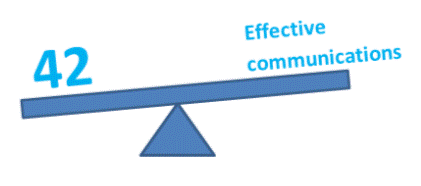
Which way do you weight effective communications?
Well, it’s hard to implement 42 so communications is certainly a more actionable answer to life, the universe and everything!
We can choose to communicate better – by learning new words, more about expressing words (from grammar to using ‘you’ more than ‘me’), developing our listening skills and practising our writing skills as good starting points.
However, I don’t think communications alone makes a great life. There’s also hard work, learning and being a good person.
What do you think are the important factors in ensuring you have the best life you can?
Do you have any examples from your business on how communications directly affected the outcome or quality of an outcome?
* If you like reading inspirational and/or thought-provoking quotes, I include one every month when I write my newsletter, business writing ideas. To keep the quote company, I also write some tips on business communications and improve a real life example of bad writing. Subscribing is simple – just fill in the form on my site.
Simple words, simple fonts
I often suggest using fewer words to make reading your message simple and easy.
Roger Dooley, author of Brainfluence, has added a new form of simplicity to effective communications – simplicity in fonts.
Research has shown that ornate fonts make a task appear to be more time-consuming than the same task written in a clearer, simpler font. An ornate font could actually make your products and services seem slow or tedious, which is obviously not an image you want to promote.
Dooley stated that a simpler font will communicate your message better because it is easier to read and looks easier to read (i.e. is more appealing). Just like a simpler message is easier and more appealing.
What do you think – does a fancy font impact on how you perceive a product or service?
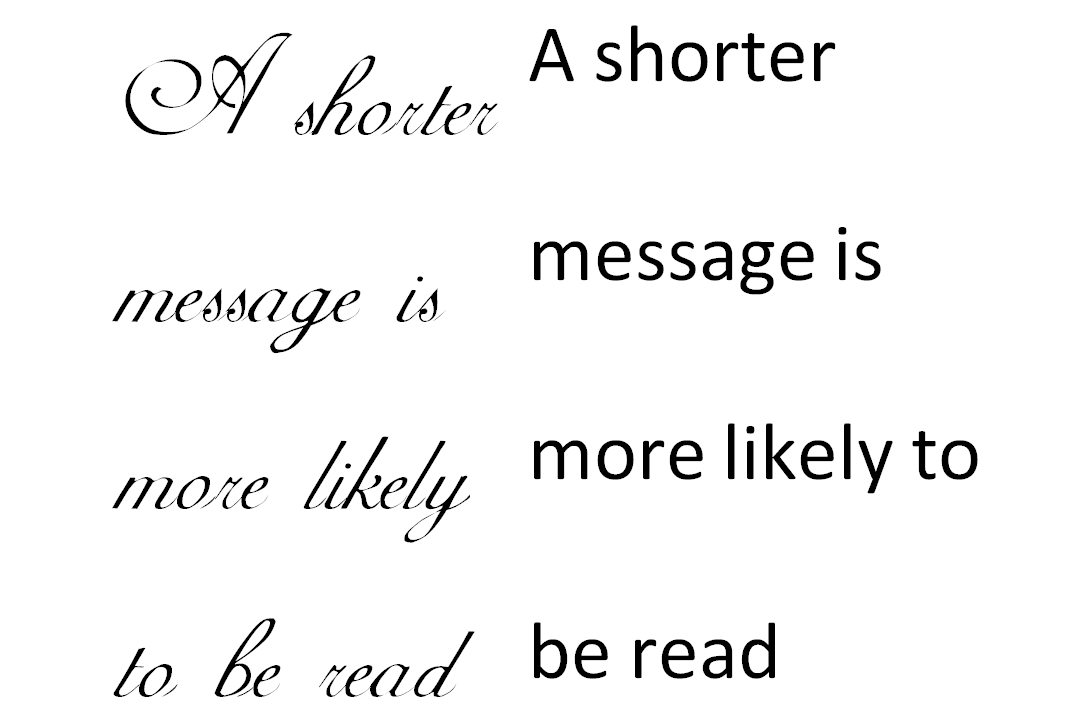
Which font is clearer?
PS The recommendation is to use a clear font such as Arial for descriptions and instructions.
Writing contracts
I’ve been asked recently about grammar and proper English for ‘important documents’ such as a contract.
Writing a contract has so much mystique and importance associated with it that many people find the thought of a contract to be intimidating. And to be honest, contracts written in legalese help that perception.
However, a contract is simply an agreement between two (or more) parties.
And a well written contract is simply communicating the details of an agreement.
A contract will outline the details of the arrangement so some contracts are much longer than others and some need much more attention to finer details such as provided by a lawyer. But the bottom line is that it is a business document and needs to communicate a clear message.
Writing contracts
Writing a contract is like any other business writing in that
- spelling is important
- grammar is important
- punctuation is important to ensure the correct meaning is understood
- good writing basics are important – for example, a contract needs no more capital letters than any other document
- clarity and simplicity make it easier to understand and read
- knowing the purpose beforehand makes it easier to write
- proof reading – and a second opinion – is critical
Client perception is your brand
Heading to Canberra in winter generally got a response along the lines of “but it’s so cold why go there now?” I know last time I went there in winter (for a conference some years ago) it was also freezing so I was expecting the worst this trip – and yes it was very cold.
Talking to people in Canberra, I got comments like “but you’re from Melbourne! You must be used to cold!” as people in Canberra and Sydney seem to have this idea that Melbourne is colder.
Reality – one city must be the colder place (or they are equally cold) but both places perceive the other as colder. The facts may be available but perceptions are strong and especially if held by a number of people.
So it is important to get a feel for how people perceive your business rather than assuming it is seen the way you want it to be seen. Social media is a great tool for measuring perceptions, but it is not the only tool available to you.
If you are not communicating the image you want, you can then change how you are miscommunicating but it may take some time to change perceptions.
By the way, Melbourne had it’s coldest night in years recently – it was 2.8. Every night we were in Canberra it was below zero – there was still thick ice on the windscreen at 9.30 one morning and I was told it was -3 mid-morning one day! If you are from Canberra, does that change your perception of Melbourne?
Giving facts alone is not going to build (or correct) the brand you want – you have to blend everything to give the right perceptions, too.
Phone or email…
When writing about including an email address on printed materials the other day, I mentioned that I prefer emails to phone calls.
Other than anyone’s personal preferences between writing and talking, here are some of the reasons I prefer communicating via email in my business:
- it is much easier to ignore an incoming email than phone call. If I am concentrating on a document for a client, I don’t like interruptions and prefer to keep working so ignore incoming messages
- I can manage my time better with emails – I choose a time to go through emails and respond as it suits me, but a phone call won’t just sit and wait for my convenience! Yes, I have an answering machine which can allow me to call back later but that doesn’t mean the other person is available when I do call back…
- I don’t always work conventional hours – I can read your email at 3am but I doubt you want me to return a phone call at such hours!
- an email forms a record of what is discussed. This makes it easier for me to check facts and deadlines when working on a project rather than relying on memory or finding where I scribbled notes during a phone call!
- in an email, I have the time, when necessary, to plan what needs to be said and how to present it; on the phone, an immediate response may be regretted later
- I can appear professional in an email no matter what is happening in the office – not always feasible over the phone in a home office with three children and renovations in the background!
That said, the phone can be quicker and easier for clarifying information or an involved discussion. And obviously my reasons don’t apply for different types of businesses.
Do you prefer email contacts over phone calls? How do you prefer to contact potential suppliers/service providers yourself?
Recent Comments