I hope you find my writing and business tips and observations useful. My business and blog are dedicated to helping businesses communicate clearly and reach their potential.
Read, and enjoy!Tash

Don’t limit an invitation to share
People love the chance to share their opinions and thoughts. So, if you invite them to share, let them share!
The story
I was filling in a survey yesterday. It asked what issue I thought was most important with a request to “please elaborate as much as you can”.
I had the time, so I wrote a detailed answer and thought I made some good points!
However, when I hit submit, an error message popped up. Apparently, my response had to be less than 200 characters!
Stunned, I tried to copy my thoughts so I could use Word to edit it with a character count tool. They had blocked the ability to cut and paste. This meant I had to guess how much to delete and try ‘submit’ a few times to get it down under 200 characters. It was infuriating.
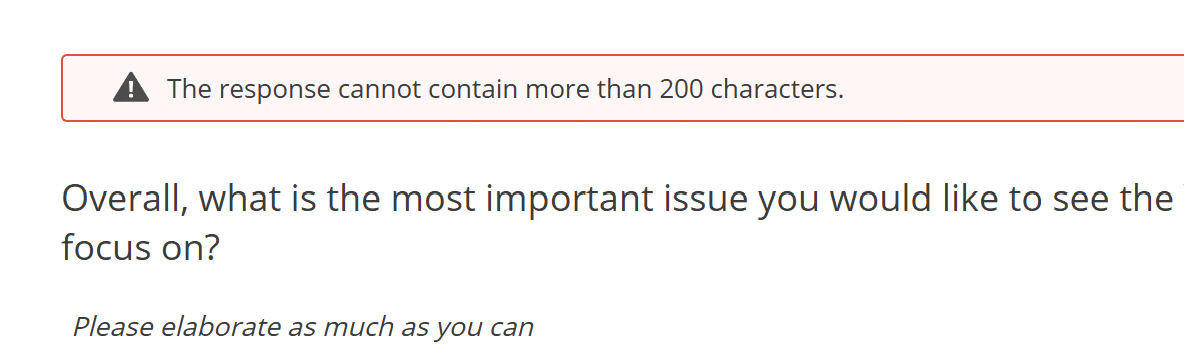
What was wrong with their communication?
The contradiction itself was frustrating and unnecessary. And the limitation was also poorly managed.
If you ask someone to elaborate as much as they can, it is a pretty clear invitation to write more than a couple of sentences. Especially with an open text box that allows you to write paragraphs!
On the other hand, if you only want short answers with a limit on words or characters, say so! Limiting the number of characters in the text box, so it becomes obvious when the limits are reached, is much clearer, too.
Succinct answers may be easier to read, group and understand, but longer answers can contain a lot more depth. Understanding why someone chooses a certain path can help you improve that path and make that path more appealing to others. In other words, limiting feedback limits what you can learn from the feedback and opinions. This question could only get limited reasons for people’s choice of issue, thereby losing the opportunity to gain more insights. Less insight is limiting the business or organisation
Limiting information engages imgaination
Today I heard a webinar based on the book The Laws of Subtraction (6 simple rules for winning in the age of excess everything). Matthew E May, author of the book was interviewed by Suzi Dafnis of ABN.
His third law hits a similar theme to what I often write so I wanted to share it.

Limiting colour can engage and stimulate imagination and thought
Law #3: Limiting information engages the imagination
This law is commonly stated as the cliché ‘less is more’ and writers are often told to ‘show not tell’ for more powerful writing.
Giving all the facts leads to overload and disinterests people so I suggest writing as little as possible to suit the message.
But I like Matthew’s twist – I believe it is true that too much information stifles imagination. Giving enough information to set a foundation is enough.
What information can you limit to get people’s imagination working in your favour?
Matthew gave the example of Steve Jobs launching the first iPhone – he showed one, explained some of what it could do and then said no more until it launched a few months later. And something like 20 million people signed up to buy one before it was on sale. That’s a lot of people acting on limited information, isn’t it?
* Image from Word Constructions
Recent Comments