I hope you find my writing and business tips and observations useful. My business and blog are dedicated to helping businesses communicate clearly and reach their potential.
Read, and enjoy!Tash

Their names are precious
Did you know that someone’s name is one of the most precious words to them?
If you don’t believe me, think about how you feel when you are ‘treated like a number’, someone pronounces your name poorly and you get a letter with your name wrong in some way.
I once got a letter that referred to Mr T Hughes, opened with Tash and had Mrs Hughes on the envelope. I didn’t like being called Mr but the lack of care shown by the inconsistency was very poor.
Getting people’s names right is a sign of respect, and in business it also shows attention to detail matters to you. So consider the following tips:
- check the spelling of someone’s name before you send a letter or email – and use their spelling even if you don’t like it
- personalise where possible – if sending a letter or email, consider adding their name to the subject and/or body as well as in the opening line
- think about what form to use – title and surname or just first name for instance will depend on your audience and your business style. Note if they have shown a preference for one style then make sure you use that style.
- if you are not sure of gender from the name, avoid using terms that indicate gender as getting it wrong can be offensive
- never make fun or joke about someone’s name, even if you think you have a friendship, unless they have done so first – even then I would hesitate before joking about their name
- wait to be invited to use a nickname or abbreviation. So many people meet a Michael or Jonathon and start saying Mike and Jon, but if Michael hates Mike it will not impress him at all. Besides, nicknames are personal and often reserved for friends
- ask how to pronounce their name if you are not sure – people don’t mind helping but may resent errors
- do your best to remember names, especially at networking events or if a client introduces you. There are many techniques for improving your name memory and it is a valuable skill to have
PS On a humorous note, I received a phone call a few days ago where the person asked “Is that Mr Tash Hughes” (badly pronounced)
I answered “No” thinking – do I really sound like a Mr?
Next question “Can I speak to Tash Hughes?”
My answer “You are – I am Tash but I’m not Mr.”
“Oh, I thought you were a boy, Goodbye” and hung up!
Capital letters
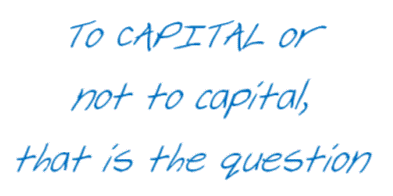
Pardon changing the Bard’s words, but this is a question that needs asking much more often …
I suspect the increased use of SMS and chat shorthand is a major factor, but it seems that many people aren’t sure about when to use capital letters in their writing. So here is a quick summary of when to use a capital letter:
- for the word I – this word must always be written as a capital letter, to do otherwise looks out of place and attracts attention to the lack of attention to detail. As part of an SMS message, I might accept it, but I leave websites where they repeatedly use a lower case i
- to start a sentence – this helps make it clear it is a new sentence and this in turn makes it easier to understand the message and individual ideas
- for all proper nouns – that is, any word that is the name of something specific for example Tash, Melbourne, Australia, Australians and Word Constructions. It does not include generic names such as mothers, business owners, writers, city or students.* Note that the word I is actually a proper noun so my first point is covered here but it was worth a separate point!
- in acronyms – where just the first letter of each word is used to represent the name of something. For instance, the ATO represents the Australian Tax Office and ASAP represents as soon as possible. It doesn’t matter if the full title uses capitals or not, acronyms generally use capitals (sometimes a business may choose to brand themselves with a lower case acronym)
- the start of speech, even if it is not the start of a sentence. For example, she said “We must pay attention to the use of capital letters.”
- days of the week and names of months, as well as names of specific periods of history (e.g. the Second World War, the Depression)
- titles of books, articles, movies and so on can be written in title case (e.g. Full Moon Rising) or just with a starting capital letter (e.g. Confessions of a supermom)
Capitals letters are sometimes also used within names (e.g. AvSuper, MacGregor), in scientific terminology (e.g. E. Coli, Eucalyptus, cyclone Tracy) and where two words have been abbreviated into one (e.g. eBooks, eLearning.)
There are variations in some of these rules, especially if you travel to another country but using these guidelines will avoid any major errors! Or call upon someone to check your writing for you – errors that requires conscious effort for you to find often are quite obvious to others, especially to someone like me who spots such things without trying.
Edited to add: I came across a fun poster with the basic capital letter uses, which is great for kids and anyone struggling to remember these rules.

* The use of a generic noun as a proper noun requires a capital letter, too. So while mothers is written in lower case, a capital letter applies in the following sentence: Mary said “Hello Mother. How are you?” Likewise, you may write about a library (generic) or the Ashburton Library (specific).
Do names matter?
When writing, the other important aspect about names is spelling.
If you are writing a note to yourself, obviously the spelling is less important. But as soon as you are writing something for a business use, it is essential you spell names correctly. That includes the names of your colleagues and competitors as well as clients, and also any business names you refer to.
Taking the time to get someone’s name spelt correctly in your records can save you time and the embarrassment of getting it wrong later.
You may not like the spellings emma-lee, elisabeth or mishell, but if that is how someone spells it, that is the way you need to spell it when refering to that person.
Getting it right shows respect; getting it wrong will annoy or even insult the person you are writing about, and can even lose you sales.

Word Constructions ~ for all your business writing needs
What’s in a name?
My daughter recently discovered that people didn’t live at the same time as dinosaurs. She was shocked and didn’t really believe it.
“But if people weren’t alive when dinosaurs were, then how can people know what they were called?” she asked.
It lead to a discussion of why we use names for things – even things that we don’t see in our everyday life. Names save us time, words and energy, as well as individualising us as people.
When writing, the choice of a name can be really important as names also set the scene. Names can give information about the person, such as gender, nationality, personality and age, and about the theme of the writing.
And it’s not just naming characters in fiction stories either. When I am writing something that includes examples, I take care to use names that imply a mix of people – for instance, using male and female names.
Word Constructions ~ for all your business writing needs
Recent Comments