I hope you find my writing and business tips and observations useful. My business and blog are dedicated to helping businesses communicate clearly and reach their potential.
Read, subscribe to my newsletter, enjoy!Tash

What is title case?
Style guides and related documents sometimes specify a system of capital letter use.
Word processing packages often give four styles to choose from:
- all lower case
- ALL UPPER CASE
- Title Case
- Sentence case
The first two are fairly self-explanatory but here is a definition of the other two common case styles.
Title case – traditionally used for the titles of everything (books, plays, movies, etc), title case has a capital letter for the start of every significant word – where words like and, of, the and a are not counted as significant. {If every word begins with a capital letter, we call it start case.}
The Little House on the Prairie
One Flew Over the Cuckoo Nest
Breakfast at Tiffany’s
Sentence case – just like you use in most sentences, only the first word and any proper nouns start with a capital letter.
The little house on the prairie
One flew over the cuckoo’s nest
Breakfast at Tiffany’s
Sentence case is the default now for most writing, including headings.
Capitalising job titles
A few months ago someone asked me (as a comment in a blog post) about capitalising the words in a job title.
My response, in summary, was that job titles don’t need to be capitalised although it is not technically wrong to do so. The exceptions being a title as part of a name (e.g. Doctor Jones) and someone in a key national role (e.g. Prime Minister, Treasurer).
I also noted that some companies list capital letters for extra words as part of their corporate style guide. Thus, we get companies writing about their Managing Director, Marketing Manager and Company when managing director, marketing manager and company would be perfectly acceptable and easier to read.
While I respect that each company can set their own brand, what annoys me is the inconsistency of such capitalisation. That is, most (maybe all!) of those companies would quite happily write about Jack the receptionist, Simone the cleaner and Justine the forklift driver while referring to Craig the Chairman and Mary the Operations Manager.
It annoys me because it is inconsistent (and therefore distracting and harder to read) but also because I find it disrespectful. Using capital letters is usually done as a sign of respect to the person in the job – does a receptionist, cleaner or forklift driver not deserve respect as well? And for anyone who says a Marketing Manager is more important than a receptionist, I ask if you could manage a busy switchboard or how you view companies you call where the receptionist doesn’t do a good job.
So, while I prefer to not use capitals for titles, if you do capitalise titles please be sure to capitalise them all.
Capitals change the meaning
It’s Monday but I’m going to do the Monday Meanings post a little differently today in honour of Anzac Day on Saturday.
Sometimes, a capital letter can change the meaning or significance of a word.
Digger: an Anzac soldier
The Diggers proudly walked off the ship in Melbourne.
digger: someone who is digging or regularly digs
Sitting in the sandpit, the digger created a moat around his castle.
The general rules for the use of capital letters obviously still apply, as does the annoyance of over using capitals. For the above example, I added a capital letter to a regular noun to make it a proper noun as I could also do for words such as Mother/mother, Father/father, Nurse/nurse and Captain/captain.
Capital letters
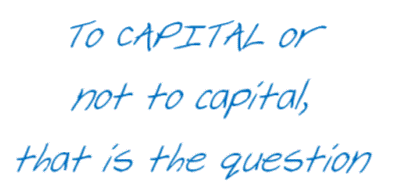
Pardon changing the Bard’s words, but this is a question that needs asking much more often …
I suspect the increased use of SMS and chat shorthand is a major factor, but it seems that many people aren’t sure about when to use capital letters in their writing. So here is a quick summary of when to use a capital letter:
- for the word I – this word must always be written as a capital letter, to do otherwise looks out of place and attracts attention to the lack of attention to detail. As part of an SMS message, I might accept it, but I leave websites where they repeatedly use a lower case i
- to start a sentence – this helps make it clear it is a new sentence and this in turn makes it easier to understand the message and individual ideas
- for all proper nouns – that is, any word that is the name of something specific for example Tash, Melbourne, Australia, Australians and Word Constructions. It does not include generic names such as mothers, business owners, writers, city or students.* Note that the word I is actually a proper noun so my first point is covered here but it was worth a separate point!
- in acronyms – where just the first letter of each word is used to represent the name of something. For instance, the ATO represents the Australian Tax Office and ASAP represents as soon as possible. It doesn’t matter if the full title uses capitals or not, acronyms generally use capitals (sometimes a business may choose to brand themselves with a lower case acronym)
- the start of speech, even if it is not the start of a sentence. For example, she said “We must pay attention to the use of capital letters.”
- days of the week and names of months, as well as names of specific periods of history (e.g. the Second World War, the Depression)
- titles of books, articles, movies and so on can be written in title case (e.g. Full Moon Rising) or just with a starting capital letter (e.g. Confessions of a supermom)
Capitals letters are sometimes also used within names (e.g. AvSuper, MacGregor), in scientific terminology (e.g. E. Coli, Eucalyptus, cyclone Tracy) and where two words have been abbreviated into one (e.g. eBooks, eLearning.)
There are variations in some of these rules, especially if you travel to another country but using these guidelines will avoid any major errors! Or call upon someone to check your writing for you – errors that requires conscious effort for you to find often are quite obvious to others, especially to someone like me who spots such things without trying.
Edited to add: I came across a fun poster with the basic capital letter uses, which is great for kids and anyone struggling to remember these rules.

* The use of a generic noun as a proper noun requires a capital letter, too. So while mothers is written in lower case, a capital letter applies in the following sentence: Mary said “Hello Mother. How are you?” Likewise, you may write about a library (generic) or the Ashburton Library (specific).
Recent Comments