I hope you find my writing and business tips and observations useful. My business and blog are dedicated to helping businesses communicate clearly and reach their potential.
Read, and enjoy!Tash

Only make useful references
I’ve been reading a number of privacy policies and notices lately – not very exciting but necessary with new privacy laws coming into effect on 12 March.
One policy included the following (slight edits made to protect that business):
Disclosure to overseas recipients
We may disclose your personal information to overseas parties. If we disclose your personal information to overseas recipients, we will do so in accordance with our Privacy Policy and the Privacy Act 1988 (Cth).

Circular links don’t really help people follow the information flow
Under new laws, you must specify if any data will be stored outside of Australia so this section is necessary. But I don’t find it particularly helpful to be told to read their policy to find out if my data goes overseas – especially as I am already reading their policy…
make references useful
- never refer back to the same document (a different section of the document is fine, of course) as it is circular and meaningless
- give enough information to make the reference easy to follow up on. For example, ‘refer to the product section of our website’ or ‘see page 6 of the member handbook’ give clarity
- if online, add a hyperlink to the appropriate page, not just the home page.
- give some idea of what can be found at the reference so people can judge if it is relevant to them. It doesn’t have to be a long list, but some guidance helps – ‘details on widget sizes’ or ‘widget care instructions’ or even ‘background research about widgets’ is more useful than ‘for more information’.
Bringing IWD into your business

International Women’s Day on 8 March – what does it mean to you?
International Woman’s Day (IWD) is on Saturday 8th March. It is both a celebration of women and an acknowledgement that many women are living difficult lives.
In some countries, IWD is a public holiday (at least for women) and is similar in importance as Mothers Day.
While it is not a holiday in Australia, you can choose to make it important – or simply acknowledge that it is important to many of your customers.
Celebrating IWD
Some of my ideas for celebrating IWD as a business are:
- treat your staff to breakfast or morning tea – even if your staff consists of you and a pot plant!
- get the males to do something nice for the women they work with (obviously this requires the men to be willing to participate!) Maybe they bring in food for morning tea, make the tea/coffee all day or ‘man the office’ so the women have a longer lunch break
- offer specials or extras to female clients for the day/week/month
- encourage women to take an interest this month, especially if you industry is not seen as particularly female-friendly or of interest to women. For example, I’ve helped AvSuper prepare information about super for women; a mechanic could run a basic car maintenance course for women; local tradespeople could teach women to do minor repairs through a class or articles in the local paper
- put up a poster in the office/shop or add a banner to the website to acknowledge women – it could be generic or somehow relate to your business
- do some fund-raising during March with the proceeds going to a women-centric organisation
- donate x% of March profits to a women’s cause
- send an email or card to your female clients thanking them for what they do (and for being your client of course!)
- sponsor a local activity or group participating in IWD – schools and sporting groups in particular may appreciate this
What ideas have you considered for your business?
Have you been inspired by another business’ involvement in IWD? What did they do?
Consistent pronouns
Mixing pronouns is a little like mixing drinks – both can lead to a fuzzy head!
Pronouns
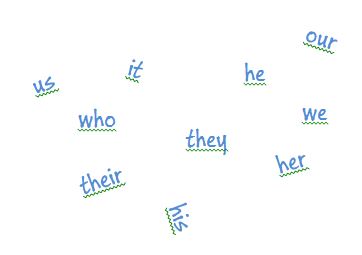
Some common pronouns that make writing (and reading) English much easier.
Just as a reminder, a pronoun is a word that is used in place of a noun. So ‘he’ replace’ John’ and ‘her’ replaces ‘Suzie’s’, and so on.
Pronouns are useful for
- making writing shorter and clearer (it takes less to write ‘they’ than ‘John, Mary, Chuan and Connor’ for example)
- avoiding repetition of the noun (compare ‘Joe rode Joe’s bike until Joe felt too tired’ and ‘Joe rode his bike until he felt too tired’)
- provide emphasis towards one noun (such as ‘The teacher herself missed the error in that question’). Mind you, this is a somewhat old fashioned way to write and I don’t recommend its use in business writing.
There are different pronouns depending on gender and whether the noun is plural or singular.
Use pronouns consistently
When using pronouns, make sure you maintain the same or matching pronoun throughout a sentence and paragraph.
I recently read
For more details about {our product}, contact us on 1234 5678 or visit their website.
The writer swaps from being part of the company (by using ‘us’) to being external to the company (by using ‘their’). Which is jarring and somewhat confusing.
If in doubt about which pronoun to use, swap in the correct noun and make sure the sentence makes sense.
Or make a conscious choice about the type of pronoun (such as if your business uses me or we, us or it), put it into your style guide and stick to it.
Do you have any trouble with pronouns? Have you ever checked the pronoun use on your website is consistent?
Correct details in tests are critical
I came across another example of errors in details being an issue.
Our daughter’s school sent out an email including ‘(1 of 2)’ in the subject. The attached pdf explained they were testing the communications system for parents so we should expect two emails – if only one arrives, contact the school.
Testing communications seems like a good plan and the test seemed simple enough.
Then I got a second email which referred to being the first email of two and had the same attachment. Was it an error to get this email twice or did they accidentally send it twice? Should I reply to say I got it twice, possibly like hundreds of other parents, or give them a chance to explain the duplication first?

Responding to a mistake can lead to a flurry of emails – avoiding that is one good reason to check details before hitting send!
Then, I got a third email asking me to log into the school’s site to read a letter. The letter was the same attachment as in the original email (which clearly states ‘this is the first email and please contact us if you don’t get a second one’).
Which detail is wrong – the letter stating a second letter was coming or the sending of the same letter twice?
Where does that put their test?
On one hand, I got both types of email so the systems are working and my contact details are correct.
Do they have my email address in the system twice so I will get two versions of every group email they send?
Was it human error to get the same attachment in the second email type or is that a failure of the system?
I can not reply as I got both emails or I can reply and explain I got three emails and the same attachment.
Which do you think will help their testing process more? What would you do?
Get the details right
Are you a details person?
Many people are bored by details (probably all of us really – we just like details in some things, not all things) and that includes details of grammar and good writing.
You can’t convince me with poor attention to details
I received a letter a few days ago.
A nicely presented letter has little value if the details in the letter are wrong.
I like getting letters, and it doesn’t happen as often now we have so many electronic options available to us. So it’s disappointing when the letter turns out to be spam or a scam rather than something interesting.
This particular letter I recognised as spam straight away as I’ve received rubbish from this group before (and so have clients who luckily ask me if it is legitimate before acting).
However, standing in the sun was nice so I actually read their letter and found numerous reasons to not act as they wished.
- they were using an email address I have never used so obviously made it up – to convince me you are credible, use my real email address
- they missed the .au in my email and website addresses – and coming from an Australian company wanting to promote me in an Australian directory makes it even more pathetic to my mind. It wouldn’t take long to look at my website to discover the .au in the URL
- it was sent to my home address but addressed to Word Constructions – a detail that made me instantly suspicious anyway.
- paragraph one includes “This now includes additional subscriber benefits listed below” which is grammatically poor; paragraph three includes “… entitle you to additional subscriber benefits (see below).”
However, the letter does not contain any subscriber benefits. - a smaller detail is lack of consistency such as “The Internet reaches 15 million… (internet analysis…” (Internet or internet – they need to choose one and list that in a style guide)
- multiple sentences were missing words or just didn’t make sense – one will be discussed and improved in my March newsletter I think!
- two sentences in a row ‘kindly’ requested me to do something – is it kind of me to sign a form to (supposedly) get promotion via their directory?
Businesses need to watch the details
Get the details right and people are not distracted by the mistakes – meaning they can focus on your call to action or message.
[Tweet “Get the details right and people are not distracted by mistakes”]
Get the details wrong and people doubt your professionalism and worry whether you pay attention to details when they are paying you. That is, if you throw together a letter instead of putting effort into every word of it, will you also rush through fixing my car, cutting my hair, building my house, designing my website and so on?
It’s nice to think people will ignore errors because we’re nice people with good intentions.
But first impressions count and if those incorrect details are the first thing a potential customer sees, it can be enough to give your competitor the job.
So how does your business avoid errors in the details?
How does your business react to potential suppliers if they get details wrong?
Answering complaints
I have been on the receiving end of poor business service recently – and it really is not pleasant.
Losing my business should be unpleasant for that supplier, too, as it means I no longer refer clients there.
Not delivering as promised has had a huge impact on my client – that put the supplier in a bad light, of course. And needing to make multiple requests to find a revised delivery date became very annoying very quickly.
But what has really made me turn my back on that supplier is how they handled these delays.
Dealing with complaints and problems
In life, sometimes things go wrong and promises aren’t kept.

Do you want your customer to be this angry? It could cost you a lot more than coins in a piggy bank if you don’t try to resolve their concerns.
When your business can’t deliver, though, you have two basic options. Be honest and apologise to the customer, or ignore it and pretend there is no problem.
Guess which option the above supplier chose…
I was given an excuse the first time I complained. The second time I was told ‘I can’t see any record of you calling on Monday’. And it still took a week for the sales person to respond to those messages. And more days before she gave me a revised date.
Every contact from the sales person had a little ‘sorry for the delay :(‘ message and ‘I look forward to hearing back from you again’ but generally ignored most of what I wrote in my formal complaint. I did not feel she was taking my concerns seriously nor that she was particularly interested in helping me get my order fulfilled.
The end result being that I am working with my bank to get a full refund and I will not use this supplier again.
Positive responses to complaints
To learn from my ex-supplier’s example, here are things they could have done to improve the situation – even if the delivery was delayed by more than two weeks.
- Ideally, they could have contacted me with an expected delivery time when I first placed the order – especially if they knew they were busy and couldn’t make the promised times on their website. And especially as I had requested this in my original order…
- As soon as I made contact about the delivery not reaching me as expected I should have received contact from the sales person. A quick ‘sorry for the delay – let me look into what is happening and get back to you’ would have been better than silence as I would have felt they were interested in serving customers
- After multiple contacts from an unhappy customer, they could have tried to help me get my delivery and feel better about them. Whether that was regular follow ups, a discount, a bonus offer or something else doesn’t matter – the lack of that meant the problem is what I associate with their brand now.
- The sales person could have actually answered my concerns in her email – and probably could have left out sad faces, frankly. I’ll give some examples of that in a separate post next week.
- Acknowledged my frustration and let me feel heard. For instance, instead of telling me they hadn’t recorded my first call they could have said ‘sorry – we should have answered you by now.’
- When they told me ‘I’ll get back to you soon’, they should have contacted me rather than wait for my next complaint. Again, it would have been much better to have kept their word by contacting me and letting me know what was happening (even if it was limited information) than let me wait and lose any confidence in their business.
Do you deal with complaints?
Have you ever thought about how you respond to complaints from customers?
It can be confronting to admit you’ve done something wrong (or less than ideal anyway) and may be tempting to hide from it, but you can turn things around if you deal with a complaint well. Or at least minimise the damage.
Preparing an attitude and perhaps a procedure ahead of time may help your business do better with complaints than my ex-supplier. I hope you do a lot better, in fact!
* Image courtesy of KozziA hansom boy?
As always, I help Love Santa write and edit some special letters each December.
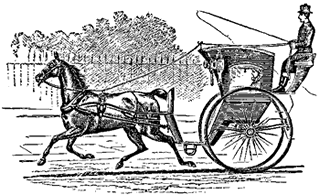
A 19th century engraving of a Hansom Cab in motion. Hansom cabs were designed to be faster and more agile than older horse drawn carriages.
As I edit, I check the supplied information works in the letters, fix up capital letters and adjust any spelling errors.
In one letter I edited a few weeks ago, I came across a misspelling I’ve never seen before so it has inspired today’s Monday meanings 🙂
handsome [adjective]: attractive, good looking; significant
You are such a handsome boy!
He received a handsome package when he retired.
hansom [noun]: a horse drawn two-wheeled carriage with a covered area which the driver sat behind and above. The hansom cab (named for its design) was the forerunner of the term taxicab and cab that we now associated with hired vehicles.)
Sherlock Holmes jumped aboard the hansom cab and was off!
How to remember which is which?
A hansom cab was designed to be sleek and fast so it has fewer letters than the significant handsome.
Alternatively, you may find it easier to think of a handsome person having a hand which a hansom cab certainly does not!
Less haste, less waste
There are a number of sayings/clichés around with the same basic message of doing things too fast can lead to errors and actually take more time.
Slow and steady wins the race
A stitch in time saves nine
Haste makes waste (or more haste, less speed)
For fast acting relief, slow down (Lily Tomlin)
And like all clichés, there is a lot of truth there – we’ve all faced the hassle of going back and redoing something we rushed the first time (or paid another price for rushing).
Uninterrupted focus
Did you know that the maximum time an average worker gets to focus uninterrupted on tasks is 11 minutes? That’s according to a University of California study, anyway.
11 minutes is nothing! It says a lot about the fast paced world we’re living in. And says a lot for behaviours like only checking emails at certain times of the day to avoid constant distractions (add in the same rule for checking social media, answering phone calls, listening to office conversations and so forth).

Even on the go, checking messages means we get no break from disruptions
The study also stated that after 20 minutes of interrupted work, people are more stressed, frustrated and feel they have a heavier workload.
Interestingly, in a follow on study run Carnegie Mellon, tests showed that after the first interruption, people do adapt a little and can cope better with subsequent interruptions. But interruptions and the threat of interruptions does reduce the effectiveness of the brain.
Are you working in a highly distracting environment? Are you aware of it stressing you?
Working from my own office, rather than in a corporate office with many people around me, probably means I tilt such averages well past 11 minutes. I do enjoy the fact that I don’t hear colleagues chatting around me, nor their phones ringing and am not distracted by people walking past my office all day.
Of course, I do have young children who are quite capable of interrupting me, too! However, between other people keeping them entertained and choosing my working hours, I minimise that issue.
I set myself work sessions where I only check emails if I need to reference something and let the answering machine manage my phone calls (and enjoy it when marketing calls are filtered!) So I do get periods of focus – and I usually get a lot achieved in those sessions, too.
I think it’s worth slowing down, not just to be more productive and feel less stressed (both worthwhile aims), but also to give your mind more time and freedom to be creative and develop ideas.
Speed up productivity
Doug Keene, Vice-Director of an air-logistics complex trying to reduce employee distractions, said multi-tasking isn’t necessarily a good thing. “When you are focused on just a few things, you tend to solve problems faster. You can’t disguise the problem by looking like you’re really busy.”
At a recent conference, Andrew May ( a performance coach), discussed these results and how stressful they are on people. He gave the following ideas and suggestions {paraphrased and added to by me!}:
- slow down – focus instead of trying to do so many things at once
- take some time out as ‘enforced isolation’ so your brain can just focus on one thing for a while – it makes you productive and can be quite peaceful. May recommends a few hours a week, at least, and to plan it for high energy times
- find a balance with recovery time to counter the stress. A five minute lunch break at your desk is not going to make up for five hours of interruptions – you need to find ways to recharge regularly.
- have some electronic free time in the evening before heading to bed so your brain can quieten before you try to sleep. You’ll end up with higher quality sleep. May suggests 45 minutes before bed you have no electronic interruptions and no caffeine; and taking a lunch break of 15 minutes without a mobile.
What can you do (or do you do) to help recover from stressful working conditions?
Do you find your productivity is clearly matched to times you do and don’t take recovery time?
Writing annual reports and attachments as one
So you have decided to have an annual report and a couple of inclusions that will be sent out with the annual report.
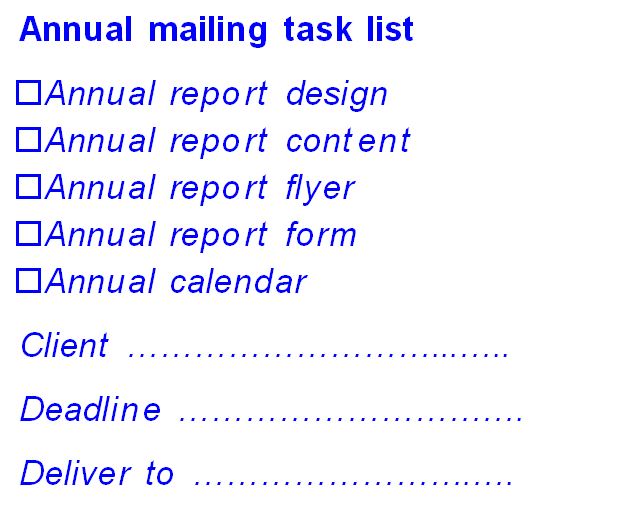
An annual report and any inclusions all form one annual mailing project.
Does this equate to three separate projects, or three parts to one project?
It is a good question, and I can see a temptation to treat them as two or there projects. Maybe you outsource the big project (the annual report) but figure you can manage the smaller ones yourself. or maybe you want to outsource to different people so the inclusions don’t distract from the annual report and vice versa.
However, I consider them to be aspects of one project and like the idea of them being managed as such. I usually mange the inclusions along with annual reports for clients, even if it is just a review and feedback on an existing document.
why consider them as a single project
Treating the annual report and any inclusions as one project works because
- they all need to be prepared by the same deadline and delivered to the same place for processing and mailing
- the various elements of the annual report mailing are linked (as they are received in same envelope) so you want consistency and to them to complement each other which is much harder to manage if created independently of each other. Even if all match the style guide, any themes and layout options may not quite fit together
- in terms of time management, I find I can work on one piece while another is with the designer or being reviewed by my client
- any images can be managed so they are only used once or duplicated in every item (as best suits the situation)
- it is easier to make references between the items. For instance, the annual report may state ‘we’re launching a new product – to find out the prices, see the enclosed flyer’. This is riskier when you can’t be sure what the other items actually include – if the flyer doesn’t include prices, the annual report reference looks silly.
Have you ever separated the annual report preparation from the inclusions preparation? I’d love to hear your reasons and the results of your effort, so please add your experiences in the comments below!
Answer customer questions
Even the negative ones.
If a customer has a question, they want you to answer it – and preferably as soon as possible so they can move on to the next step.

Answer potential customer questions to get more customers
Look at your website, brochures, social media profiles and other written messages – do you answer customer questions?
Smaller documents can only answer a few questions, obviously, but make them important questions (like how to contact you for further answers!)
Scary questions
Some businesses are scared of people asking a certain question – or act that way anyway.
Why not stand out by being the brave business? It is honest and gives customers fewer things to worry about because you have answered their questions.
And it gives you a chance to make things more positive, too.
So a dentist website can include “will it hurt? Well, yes it might but we’ll warn you and do whatever we can to minimise it.”
Here are some more industry specific examples…
- personal trainers: ‘do I really have to work out in between visits?’ ‘Only if you want the best results!”
- accountants: ‘am I going to have to dig out all my old receipts?’ ‘I’m afraid so – the more receipts we get, the more we may be able to get back for you at tax time!’
- editors: ‘will you really point out all my spelling mistakes?’ ‘Yes, that’s what you’re paying us for – but we promise not to make you feel bad about any of them!’
- online shops: ‘do you charge postage and delivery?’ ‘Yes we do. We decided to charge official postage rates rather than increase the prices of everything to cover delivery.’
Do you answer any potentially negative questions in your materials? How have clients responded to those answers?
If you want some ideas on what questions customers may silently being asking – and how to answer them nicely – then contact me soon so we can help your customers find what they need.
Recent Comments