I hope you find my writing and business tips and observations useful. My business and blog are dedicated to helping businesses communicate clearly and reach their potential.
Read, and enjoy!Tash

Consistent terminology
Do you know what a closed question is?
I’m sure I didn’t learn about open and closed questions until much later, but my children are learning this in primary school. This is a good thing as it can help them communicate socially as well as within their school work.
Closed questions – elicits a simple response. For example, the question “do you like blue or green?” can be answered with one word.
Open (or open ended) questions – give scope for more detailed and complex responses. Open questions such as “why is blue your favourite colour?” or “what do you like about that book?” require longer answers and can lead to a discussion.
Thick and thin questions?
Have you ever heard questions referred to as thin and thick questions rather than open and closed?
The first time I knew of the thin/thick nomenclature was when I saw some work my daughter did at school. I know enough about open/closed questions to figure out what was meant by thin and thick so I interpreted the schoolwork very quickly. And I assumed the children had been taught thin/thick instead of open/closed.
Then I read the schoolwork in more detail.
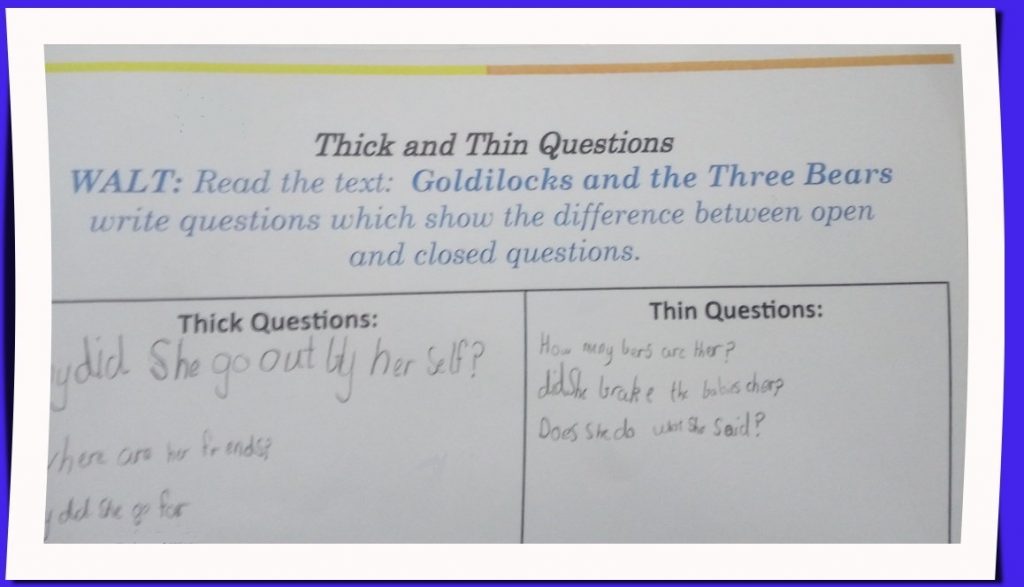
The instructions swap between thick/thin and open/closed questions without any explanation that they are the same concept (and not even in the same order which makes it even harder to correlate the pairs of words). Given that this activity is obviously aimed at teaching children about open/closed questions, surely it would be better to use the same terminology for the one activity.
It’s one thing for me as a professional writer to read these instructions and follow them easily. It’s something else entirely for a seven year old who is grappling with what these terms mean and finding examples of each type!
And my daughter said they were only taught about open/closed questions – she figured it out (and I think she did a good job devising relevant questions in the activity). I’m sure many of her classmates would have struggled if they were left to do this activity just by reading the instructions.
The lesson?
If you start using one term (or set of terms) when writing, then continue using that term throughout.
Even if you explain there are alternatives, stick to one term in your content. For instance, if you are writing about saving money, you may write something like
Contributing to your savings can be done more or less frequently. Contributions, also known as deposits or account credits, will attract interest and thus increase your savings over time. When deciding how much to contribute, you may consider your income, expenses and lifestyle choices.
You may not be writing for children, and your audience may easily figure out your message, but why make it harder to read than necessary? Why risk them not understanding and/or disengaging in your content?
Being consistent makes your writing easier to read and understand, looks more professional and will probably help search engines recognise a keyword in your online writing.
Consistent pronouns
Mixing pronouns is a little like mixing drinks – both can lead to a fuzzy head!
Pronouns
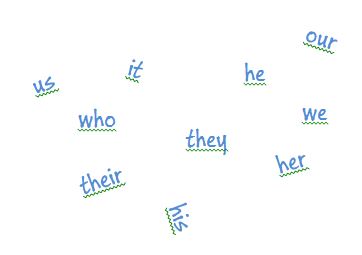
Some common pronouns that make writing (and reading) English much easier.
Just as a reminder, a pronoun is a word that is used in place of a noun. So ‘he’ replace’ John’ and ‘her’ replaces ‘Suzie’s’, and so on.
Pronouns are useful for
- making writing shorter and clearer (it takes less to write ‘they’ than ‘John, Mary, Chuan and Connor’ for example)
- avoiding repetition of the noun (compare ‘Joe rode Joe’s bike until Joe felt too tired’ and ‘Joe rode his bike until he felt too tired’)
- provide emphasis towards one noun (such as ‘The teacher herself missed the error in that question’). Mind you, this is a somewhat old fashioned way to write and I don’t recommend its use in business writing.
There are different pronouns depending on gender and whether the noun is plural or singular.
Use pronouns consistently
When using pronouns, make sure you maintain the same or matching pronoun throughout a sentence and paragraph.
I recently read
For more details about {our product}, contact us on 1234 5678 or visit their website.
The writer swaps from being part of the company (by using ‘us’) to being external to the company (by using ‘their’). Which is jarring and somewhat confusing.
If in doubt about which pronoun to use, swap in the correct noun and make sure the sentence makes sense.
Or make a conscious choice about the type of pronoun (such as if your business uses me or we, us or it), put it into your style guide and stick to it.
Do you have any trouble with pronouns? Have you ever checked the pronoun use on your website is consistent?
Content and message must match
Whatever your message is, your content must be consistent as well.
One of my favourite writing tasks is helping Santa write letters each Christmas at Love Santa. They are fun, positive letters and I know that each one will bring smiles and extend the Christmas joy.
Of course, sometimes people feel that they get too old for Santa and question their belief in him and the magic of Christmas.
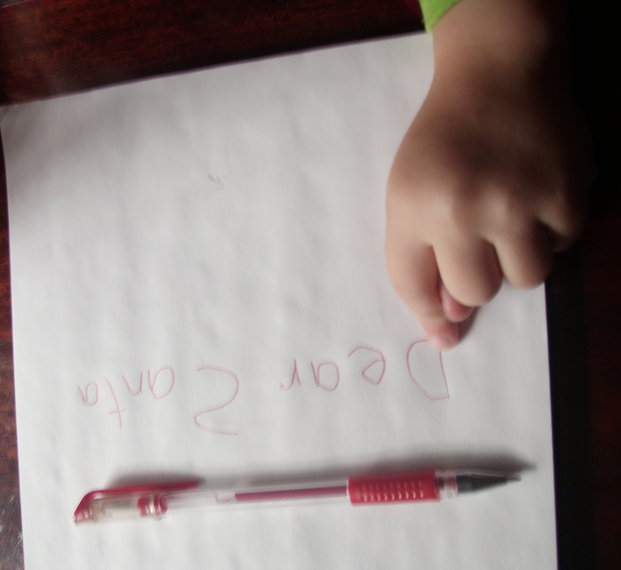
Writing letters to Santa
Like many others, Love Santa has some information available to help people (parents in particular) to encourage people to keep their belief in Santa. The information is written with care to give tips on encouraging belief but also be read by those in doubt without any additional cause to doubt (and yes, this blog post is also being carefully written!)
Others are not so careful. I just read an article with ‘easy ways to keep your child believing in Santa’ that spends the first few paragraphs destroying any beliefs before giving the five tips. Any doubting child reading it would no longer be influenced by those useful tips so the purpose would be lost – and don’t assume kids don’t read articles aimed for parents!
This makes a clear example of how the presentation of information through choice of words, headings and images can support or contradict the intent and content of the writing. Sure it is harder to write so that the entire message is consistent and acceptable for all potential readers, but it will serve the purpose much better and will be appreciated by those looking for the information.
What examples have you seen of a message not supporting itself? Or maybe you have a Santa story to share (although personal stories are best shared at Love Santa’s blog!)?
Recent Comments