I hope you find my writing and business tips and observations useful. My business and blog are dedicated to helping businesses communicate clearly and reach their potential.
Read, and enjoy!Tash
Mixing pronouns is a little like mixing drinks – both can lead to a fuzzy head!
Pronouns
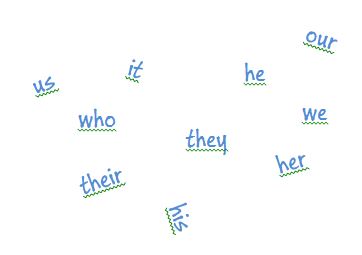
Some common pronouns that make writing (and reading) English much easier.
Just as a reminder, a pronoun is a word that is used in place of a noun. So ‘he’ replace’ John’ and ‘her’ replaces ‘Suzie’s’, and so on.
Pronouns are useful for
making writing shorter and clearer (it takes less to write ‘they’ than ‘John, Mary, Chuan and Connor’ for example)
avoiding repetition of the noun (compare ‘Joe rode Joe’s bike until Joe felt too tired’ and ‘Joe rode his bike until he felt too tired’)
provide emphasis towards one noun (such as ‘The teacher herself missed the error in that question’). Mind you, this is a somewhat old fashioned way to write and I don’t recommend its use in business writing.
There are different pronouns depending on gender and whether the noun is plural or singular.
Use pronouns consistently
When using pronouns, make sure you maintain the same or matching pronoun throughout a sentence and paragraph.
I recently read
For more details about {our product}, contact us on 1234 5678 or visit their website.
The writer swaps from being part of the company (by using ‘us’) to being external to the company (by using ‘their’). Which is jarring and somewhat confusing.
If in doubt about which pronoun to use, swap in the correct noun and make sure the sentence makes sense.
Or make a conscious choice about the type of pronoun (such as if your business uses me or we, us or it), put it into your style guide and stick to it.
Do you have any trouble with pronouns? Have you ever checked the pronoun use on your website is consistent?
Our daughter’s school sent out an email including ‘(1 of 2)’ in the subject. The attached pdf explained they were testing the communications system for parents so we should expect two emails – if only one arrives, contact the school.
Then I got a second email which referred to being the first email of two and had the same attachment. Was it an error to get this email twice or did they accidentally send it twice? Should I reply to say I got it twice, possibly like hundreds of other parents, or give them a chance to explain the duplication first?
Responding to a mistake can lead to a flurry of emails – avoiding that is one good reason to check details before hitting send!
Then, I got a third email asking me to log into the school’s site to read a letter. The letter was the same attachment as in the original email (which clearly states ‘this is the first email and please contact us if you don’t get a second one’).
Which detail is wrong – the letter stating a second letter was coming or the sending of the same letter twice?
Where does that put their test?
On one hand, I got both types of email so the systems are working and my contact details are correct.
Do they have my email address in the system twice so I will get two versions of every group email they send?
Was it human error to get the same attachment in the second email type or is that a failure of the system?
I can not reply as I got both emails or I can reply and explain I got three emails and the same attachment.
Which do you think will help their testing process more? What would you do?
You can’t convince me with poor attention to details
I received a letter a few days ago.
A nicely presented letter has little value if the details in the letter are wrong.
I like getting letters, and it doesn’t happen as often now we have so many electronic options available to us. So it’s disappointing when the letter turns out to be spam or a scam rather than something interesting.
This particular letter I recognised as spam straight away as I’ve received rubbish from this group before (and so have clients who luckily ask me if it is legitimate before acting).
However, standing in the sun was nice so I actually read their letter and found numerous reasons to not act as they wished.
they were using an email address I have never used so obviously made it up – to convince me you are credible, use my real email address
they missed the .au in my email and website addresses – and coming from an Australian company wanting to promote me in an Australian directory makes it even more pathetic to my mind. It wouldn’t take long to look at my website to discover the .au in the URL
it was sent to my home address but addressed to Word Constructions – a detail that made me instantly suspicious anyway.
paragraph one includes “This now includes additional subscriber benefits listed below” which is grammatically poor; paragraph three includes “… entitle you to additional subscriber benefits (see below).”
However, the letter does not contain any subscriber benefits.
a smaller detail is lack of consistency such as “The Internet reaches 15 million… (internet analysis…” (Internet or internet – they need to choose one and list that in a style guide)
two sentences in a row ‘kindly’ requested me to do something – is it kind of me to sign a form to (supposedly) get promotion via their directory?
Businesses need to watch the details
Get the details right and people are not distracted by the mistakes – meaning they can focus on your call to action or message.
[Tweet “Get the details right and people are not distracted by mistakes”]
Get the details wrong and people doubt your professionalism and worry whether you pay attention to details when they are paying you. That is, if you throw together a letter instead of putting effort into every word of it, will you also rush through fixing my car, cutting my hair, building my house, designing my website and so on?
It’s nice to think people will ignore errors because we’re nice people with good intentions.
But first impressions count and if those incorrect details are the first thing a potential customer sees, it can be enough to give your competitor the job.
So how does your business avoid errors in the details?
How does your business react to potential suppliers if they get details wrong?
But it has made me think about choices of words and the hidden context of words we sometimes need to be aware of when we communicate to people. Especially to people we may not know well so may not know what context they will use to understand our words.
Similar words convey different messages
The day Tony died, we went to the nursing home he had been in.
A lovely staff member spoke to us and would only refer to Tony passing. She was obviously very uncomfortable with saying someone had died.
Conversely, other people I spoke to during the week commiserated and mentioned people they had lost in the past.
While most of us would understand what someone means with ‘ we lost my father-in-law last week’, it doesn’t feel right to me. At least in part because it reminds me of a comedian routine giving responses such as ‘was he labelled so someone could return him’ and ‘that was careless of you’.
Having written many things for superannuation funds, I have had to write about death (that is, explain their life insurance policies). And again it is interesting how different people react to this topic.
In my usual less-is-generally-best style, I write ‘if you die’. Various fund staff wanted words like ‘in the event of your death’ because it seemed softer or less ‘in your face’.
A few years ago, I interviewed Robyn O’Connell for an article. As well as having written a book on death for children (which I made use of with my children leading up to the funeral), Robyn is a celebrant and has done a lot of work around bereavement.
Robyn was strongly of the belief that saying die/dead is better than any euphemism because it is clear (which appeals to me!) and makes it easier to accept the reality to aid the grieving process.
Choosing the right word
It’s not just about the obvious meaning. We need to choose words that give the right meaning without the incorrect hidden message or the wrong emotional reaction.
What thoughts and feeling do you have to die compared to passed away compared to lost or any other euphemism you know?
Someone calling a rose by another name puts the wrong images into our minds. Of course, if a rose actually had a different name it may be perceived differently – who knows!
I wish I had taken a photo of the roses we had on the coffin on Monday. They were beautiful and would have suited this post perfectly.
But I didn’t think of taking photos during a funeral and wasn’t really in that emotional place anyway.
Interestingly, someone did take photos at the funeral – perhaps not at the church but certainly at the cemetery and wake. I was surprised to see him doing so but not offended by it. How would you feel about someone taking photos in an unexpected setting such as a funeral?
In memory of Tony
Tony Brown, Graduation photo, University of Melbourne, 1959
It has been a tough week. And this is where I indulge in something more personal in the form of a mini tribute to a lovely man.
Tony was a gentle man, a very generous man who gave a lot. For one thing, he was president of the E W Tipping Foundation for 21 years. Intelligent and respectful, Tony was a man of few words.
A loving father and grandfather, Tony will be missed by many. The number at his funeral showed that, too.
Distractions made it hard to read – and poor grammar can be a distraction
Some people struggle with the questions ‘does this word need a capital letter?’ and others use so many unnecessary capital letters that just frustrate readers – excess capital letters actually make text harder to read (and more time-consuming to write, too!)
Poor capitalisation distracts
Some competition terms I recently read confused me because of a poor capital letter use. By adding a capital letter mid-sentence, I thought it was missing a full stop and a new sentence had started – but reading it as a new sentence didn’t make sense.
Entry is open to all Client bookings made with…
What do you think – did the capital C for client distract you?
In my mind, if you have to reread a sentence to understand it, the writing has failed. Good writing is easy to read and lets the reader focus on the message, not the words. {Obviously it’s different if you reread it because you can’t understand a difficult concept!}
Presumably, lack of clarity in something like competition terms or a contract has potential legal implications.
It is February and we’re almost at Valentines Day.
Personally, I don’t care about the commercialism of the day. I consider it a reminder to acknowledge those people we care about, both romantically and otherwise, in a way we probably don’t think of throughout the year.
I aim to send a note, letter or email to people close to me for Valentines Day, just so they know I care all year, even when I forget to tell them.
And for those interested, Valentines Day, Valentine’s Day and Valentines’ Day are all grammatically correct! It depends which grammar rule you believe is more important as to how you write the word!
Valentines Day – the name of an event, such as Good Friday or Christmas Day
Valentine’s Day – the day owned by or relating to Valentine
Valentines’ Day – the day owned and celebrated by valentines (lovers) everywhere
The same answer applies to Mothers and Fathers Day, too.
So what is your preference for writing Valentines Day? Is that just what feels right or have you thought about what is ‘correct’?
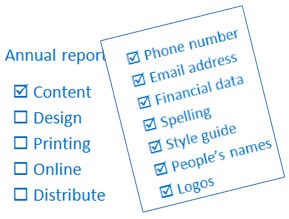
Producing an annual report is a huge job – there are so many details to co-ordinate. Before signing off a final draft, I always get the following items checked at least once, often using different people for specific list items so they can focus and are more likely to spot any errors.
Annual report checklist
company data
ABN and similar numbers
phone number
address
online addresses
logo is present and used according to the style guide
contents page numbers
spelling (especially company, people and product names)
technical details (eg is it $36 per 100g or 100kg?)
figures and data (eg financial tables, returns data)
If all the above have been checked thoroughly, your annual report is correct and can be signed off ready for publication.
It’s easy to rush through this section because time is running out nad everyone’s a bit over the whole project by the end. However, it is such an important part of the process and needs to be carried out diligently (such as having multiple people involved).
When planning the annual report process, I always allow a week and preferably two weeks for the review. Not only does this reduce the rush, it gives me spare time if changes are required and a second review becomes necessary.
Do you have a checklist for finalising an annual report or similar large project? Do you involve multiple people in the review process?
Quality content is more than the message – it also has to be presented in a way that is easy for people to read and understand.
Many people will tell you that the message is more important than spelling or grammar – and it is, but only to a point. A great message is lost if the spelling and grammar are poor.
Last night, I saw a page on a website that shows how important spelling can be – as even one wrong letter can make a big difference.
We make real-estate CD’s. [Business] can also make and host your web site, with promotion as the key fucus.
Using a u instead of an o is not just a typo we can ignore – the new word is too close to another word and that is what now catches our attention – not the original message.
It also changed the reader’s interpretation of the ‘presenting in a unique way’ in the following sentence, creating giggles instead of interest in their professional services.
It comes back to proofreading your work – not just a quick glance or use of a spell check, but a genuine check of what you have written. And the best proof reading is done a day or so after the writing or by another person. The quality of your content will improve through this simple process and maintaining a ‘focus’.
It may seem like a strange blog heading, the grammar of blog headings, but I was asked the question so here is my answer!
The heading or title of a blog post is usually the first thing someone will see and has a huge impact on whether anyone reads the actual content of the post, and therefore on the success of that blog post. Making it enticing is worth spending some time on, and you don’t want to undo those efforts by using inappropriate grammar and spelling.
So what is the correct format for a blog heading?
Do not write it all in capital letters – that is considered to be yelling and therefore arrogant, plus it is harder to read anyway
Use basic grammar and punctuation rules such as a capital letter for a noun, match plural/singular nouns and verbs, and put apostrophes in the correct places
Check all words are spelt correctly
Make sure the title makes sense. Titles can sometimes have fewer words than an equivalent sentence (e.g. ‘the grammar of blog headings’ is fine for a title but in the body of a post I need to add more such as ‘the grammar of a blog heading can impact on your credibility.’) but include enough words to convey the meaning (I couldn’t use ‘The grammar blog headings’ for instance)
Have you noticed bad grammar in any titles? How did that impact on you reading that blog post (or article)?
I was happily reading a blog post nicely laid out with tables and sub-headings when I came across a sentence “change your pricing strategy to suite your business needs.”
I’ll say no more other than to give a new pair of misused words…
A business woman in a suit on a lounge suite – one little letter makes a world of difference.
suit: (verb) to be acceptable to or enhance something Will it suit you to meet at 10am on Wednesday?
Does your pricing strategy suit your business needs?
suit: (noun) a set of clothing, generally consisting of a jacket with pants or skirt; legal action; one of four divisions in a pack of cards club, diamond, spade, heart); a romantic interest. Most men wear a suit to a funeral. Jason was very pleased when he won the law suit against his competitor. Rachel’s hand of cards included every suit. After three years, Elizabeth accepted his suit.
suite: related things together as a set, such as a group of rooms in a hotel or a set of furniture for one room; music in one key but several parts Jane ordered a new bedroom suite at the sales.
These are the types of errors I spot naturally and instinctively correct for clients so if you are concerned about your word usage don’t worry about showing your writing to a professional writer/editor – apart from the fact we’ve seen it before, it is better one professional sees it and fixes it than you publish it and your prospective clients see it, don’t you think?






 The heading or title of a blog post is usually the first thing someone will see and has a huge impact on whether anyone reads the actual content of the post, and therefore on the success of that blog post. Making it enticing is worth spending some time on, and you don’t want to undo those efforts by using inappropriate grammar and spelling.
Recent Comments